

Visko has launched Orbis, a video model that generates a scene in real time and keeps generating it while the prompt changes underneath. Conventional video tools take a prompt, run for a while, and hand back a finished clip that is fixed once it arrives, so any change means paying for a fresh generation and discarding what the last one built. Orbis runs continuously instead, streaming frames as they are produced, and a new instruction typed mid-stream lands in the output without restarting the run.
Visko calls this class of system a Live Model, meaning a model that runs as an ongoing process tied to real time and carries its state forward for as long as it runs. A memory layer keeps subjects, scenes, and style consistent as the video extends, and because that memory sits inside the model instead of a growing transcript, the cost of carrying the past stays roughly flat as a run gets longer. The company reports hour-long runs that hold steady on visual quality and color without drifting. Orbis accepts text, an image, or an existing video as a starting point, takes prompts in multiple languages, and delivers 4K at 24 frames per second through a serving stack built for continuous generation. Visko puts the delay between a typed change and a visible one under a second on average. Internally, it generates at a lower resolution and passes the result through a streaming upscaler, so 4K arrives without waiting for a full sequence to finish.
The technical report measures Orbis on 74 test cases, each a video of one to three minutes carrying six prompt changes, with every segment scored against whichever prompt was active at the time. On that set, Orbis takes the top position for perceptual quality, motion quality, and prompt alignment under the DOVER and VideoAlign metrics, measured against real-time video systems including Self-Forcing, LongLive, and SANA-Video. On a separate aesthetic measure, it places third, behind SANA-Video and LongLive.
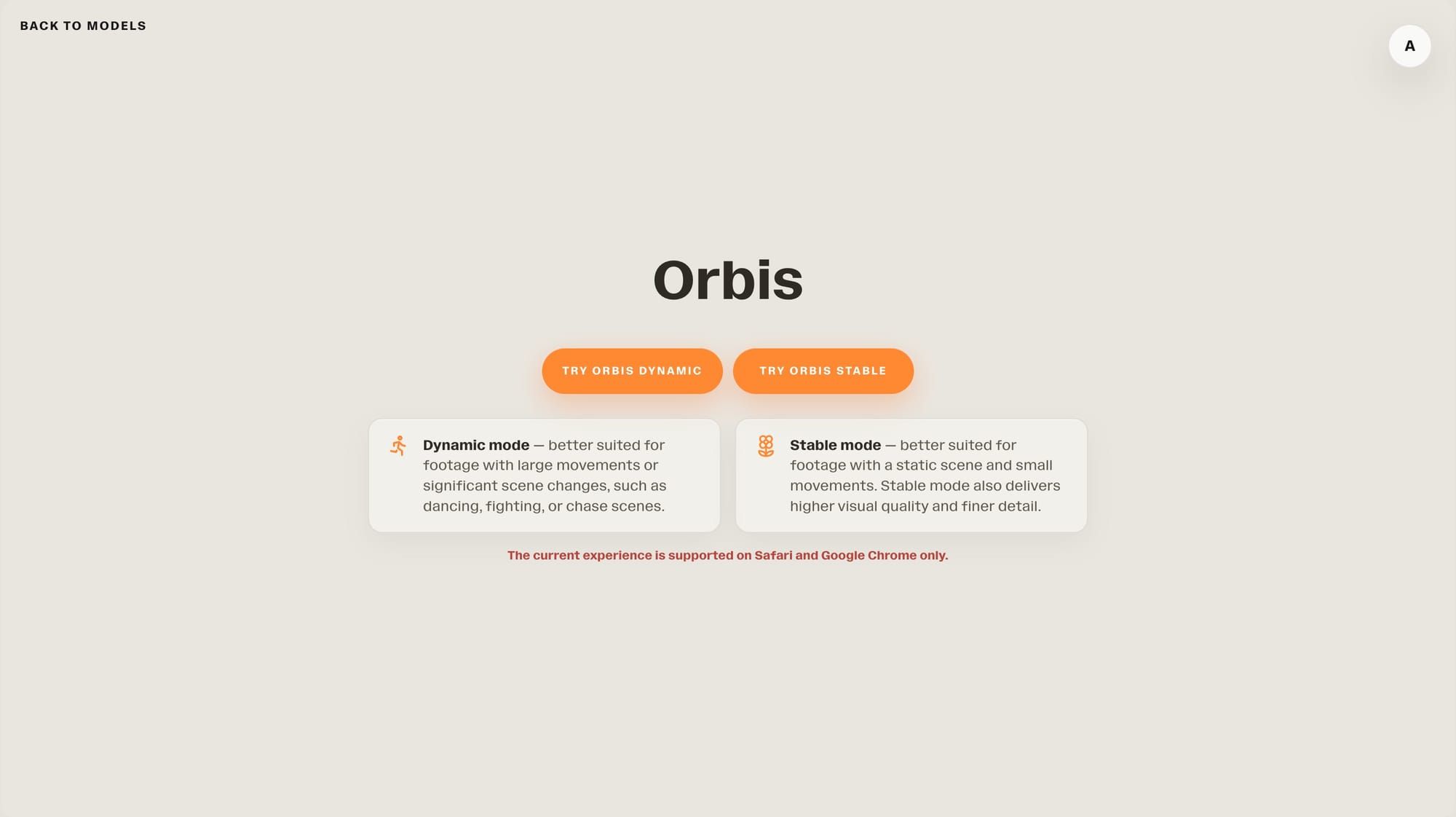
Orbis runs on the Visko site behind a sign-in, with demos covering branching stories, voice-driven generation, robot training scenes, and a freeform playground for building a world from text or a reference image. Two generation modes are offered, one for high-motion scenes and one for slower scenes with finer detail. Intended users span entertainment and live streaming, virtual companions, education, and robotics teams wanting a simulated environment to train in before a machine acts in the real world.
Test out Visko Orbis for yourself
Visko Platform is based in Sunnyvale, California, and was founded in 2025. Orbis sits alongside two narrower models from the same team: Morphe, which swaps or animates a person while leaving the rest of the frame intact, and Kinesis, which adds or alters elements at a chosen point in space and time. The company argues video generation is moving from tools that return a clip toward processes that keep running, priced by the hour of a world staying live. The launch comes alongside a $10 million pre-seed round.


