

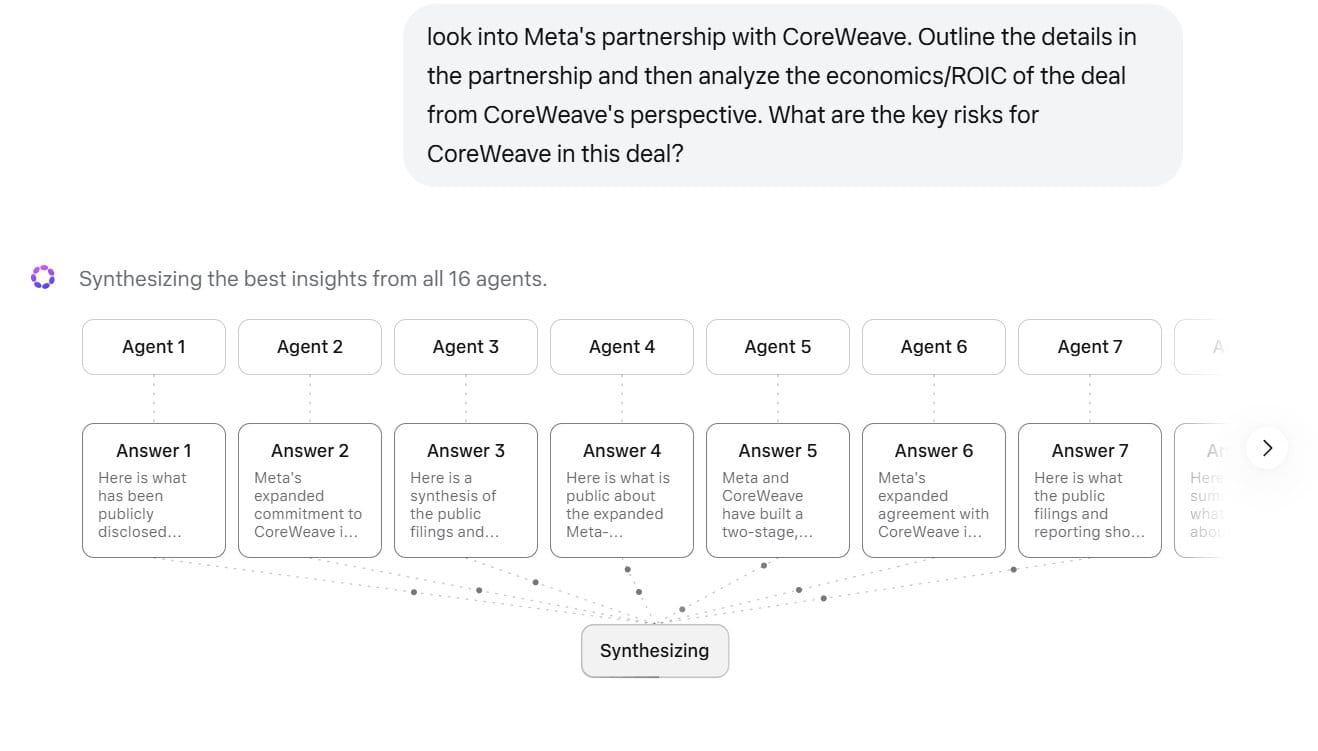
Meta has begun rolling out Contemplating mode for Muse Spark, its new flagship AI model built by Meta Superintelligence Labs. The mode orchestrates multiple agents that reason in parallel, with up to 16 working simultaneously on a single prompt before synthesizing a unified response. Users have started seeing a dedicated selector in the Meta AI app that lets them toggle the feature on explicitly, giving them control over when to deploy this heavier reasoning approach. Contemplating mode achieved 58% on Humanity's Last Exam and 38% on FrontierScience Research, putting it in direct competition with the most capable reasoning tiers from Google and OpenAI.
Meta AI is actually very powerful (yes)
— Paul Couvert (@itsPaulAi) April 12, 2026
You can enable the "contemplating" mode which will start 16 (!!) agents to work on your prompt.
They will autonomously:
- Research
- Refine
- Answer
And then ALL THE 16 ANSWERS will be synthesized to give you the best possible result.… pic.twitter.com/XEiAMKrRXQ
The closest parallel to this approach is xAI's Grok Heavy mode, which distributes reasoning across a 16-agent pool of specialized sub-models operating in parallel. The critical difference is accessibility: Grok Heavy is restricted to SuperGrok subscribers at roughly $30 per month or X Premium+ users, while Meta is offering Contemplating mode at no cost. For a company that just rebuilt its entire AI stack under Alexandr Wang's leadership after the Llama 4 disappointment, making frontier-class multi-agent reasoning free is a deliberate play to pull users away from paid competitors.
Contemplating mode is rolling out slowly, everyone will get a chance to try it soon! https://t.co/NVqiluNOJv
— Jack Wu (@JackTripleU) April 11, 2026
The early numbers suggest the strategy is working. The Meta AI app jumped from No. 57 to No. 5 on the U.S. App Store within a day of Muse Spark's launch, and the app has been installed 60.5 million times worldwide, with 25 million downloads in 2026 alone.
Independent analysis from Artificial Analysis placed Muse Spark fourth on their Intelligence Index, trailing Gemini 3.1 Pro Preview, GPT-5.4, and Claude Opus 4.6, but still firmly in the top tier globally. Whether Contemplating mode can sustain that momentum depends on how it performs beyond benchmarks, but offering what rivals charge a premium for, at zero cost, is the kind of move that could reshape how consumers choose their default AI assistant.


