


Ornith has released Ornith-1.5, a family of open models that extends the self-scaffolding framework from Ornith-1.0 into a closed self-improvement loop. Where the previous generation wrote the scaffold around a fixed set of human-curated tasks, Ornith-1.5 proposes the tasks themselves, generates a task-specific scaffold for each one, and produces the solution rollouts used for reinforcement learning. The release covers three scales: a 397B mixture-of-experts flagship, a 35B mixture-of-experts model activating 3B parameters per token, and a 9B dense model shipping with a quantized Mobile build for iPhone and Android.
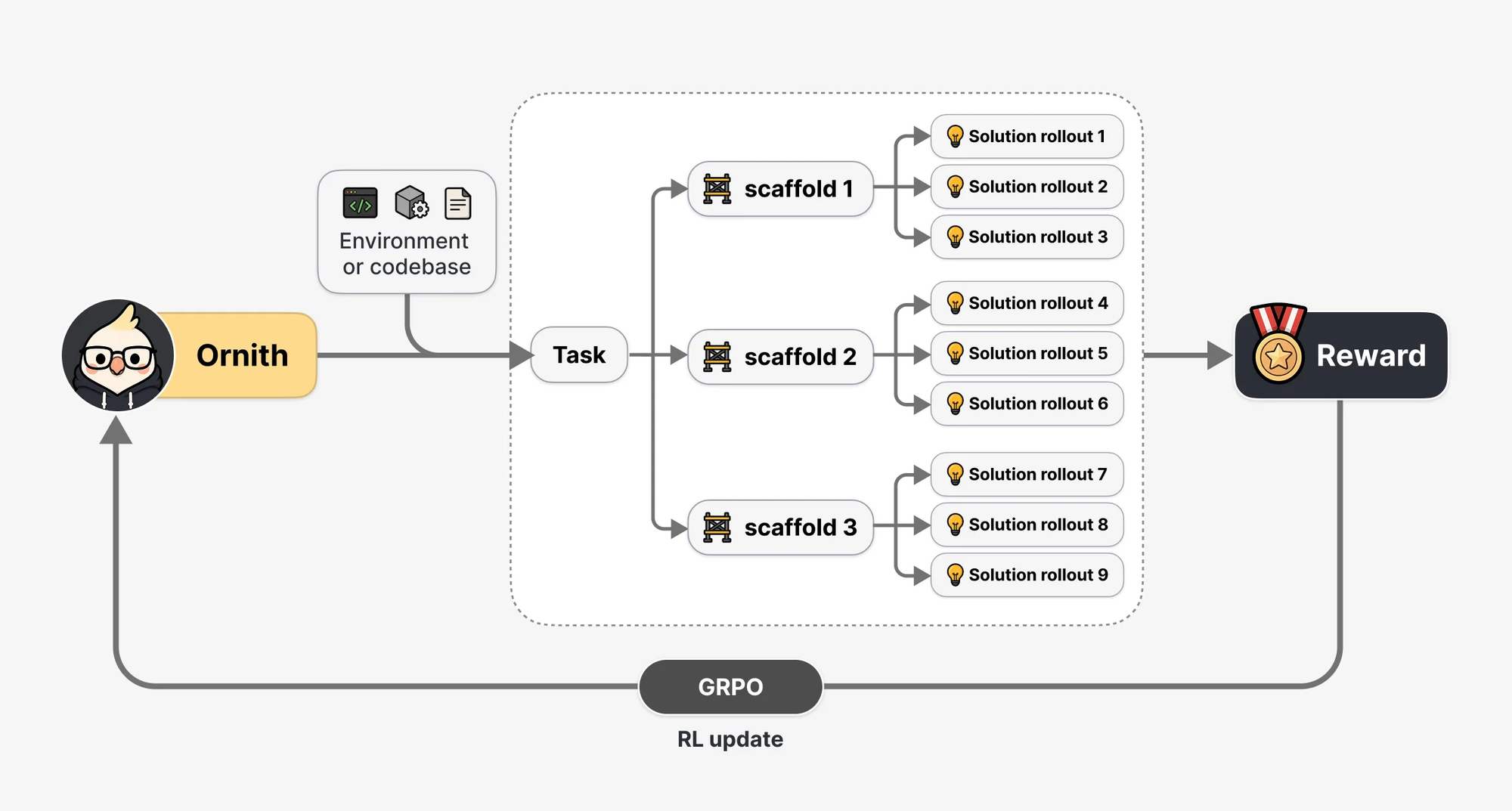
Each training cycle runs in three stages. Given an environment or codebase, high-level instructions about the task type, and the model's own history of solved problems, the system proposes progressively harder tasks that sit beyond what it has already handled. It then generates or refines a scaffold covering instructions, tools, decomposition strategy, and orchestration, and produces a rollout conditioned on both. Reward propagates back across all three stages, so the system learns to write better solutions, more useful training tasks, and more reliable evaluation harnesses at once. Task reward multiplies three signals: whether the task and scaffold form a valid and verifiable environment, whether difficulty sits near the current capability frontier, and whether the task is novel against work already generated. Frontier difficulty targets a 0.2 empirical success rate, so a task loses value to the generator once the model starts clearing it reliably. Validity acts as a hard gate that zeroes out malformed tasks, and all three stages are optimised with GRPO.
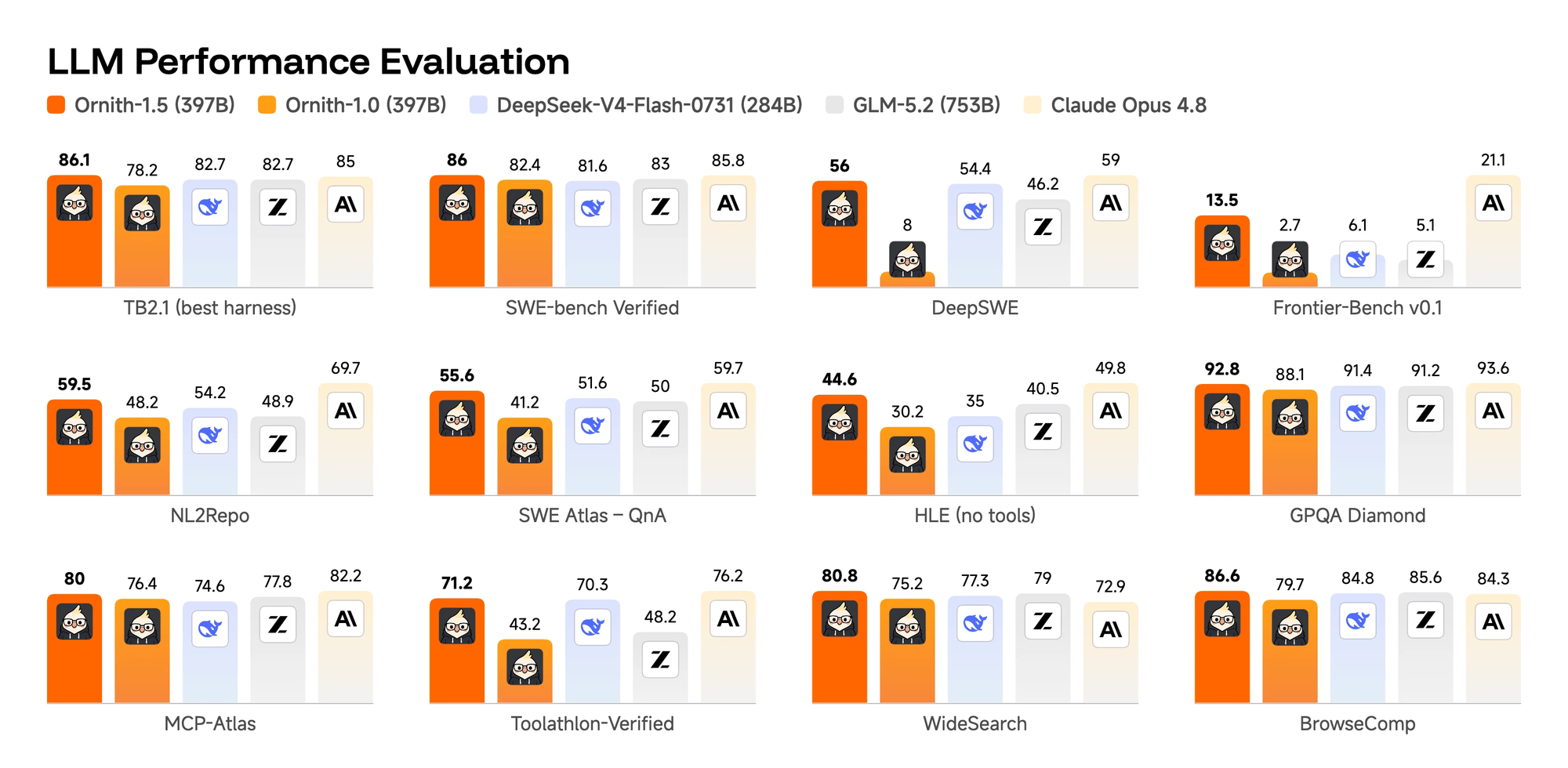
On the company's published tables, averaged over five independent runs, Ornith-1.5-397B scores 85.1 on Terminal-Bench 2.1 and 56.0 on DeepSWE, which Ornith reports as on par with Claude Opus 4.8 at 85.0 and 59.0 and ahead of GLM-5.2 and DeepSeek-V4-Flash-0731 at comparable scale. The 35B reaches 68.5 and 79.0 on Terminal-Bench 2.1 and SWE-Bench Verified while activating 3B parameters per token, and the 9B reaches 47.0 and 70.6, which the company places above Gemma 4-31B and Qwen 3.6-35B. Coverage extends past coding into reasoning and agentic work, with 92.8 on GPQA Diamond and 86.6 on BrowseComp at flagship scale.
Check out the weights and full tables
Ornith is the model line from DeepReinforce, the research team that shipped Ornith-1.0 in June 2026 across 9B dense, 31B dense, 35B MoE, and 397B MoE variants under an MIT license, with weights on Hugging Face. That release was post-trained on Gemma 4 and Qwen 3.5 checkpoints and introduced the idea of treating the scaffold as a learnable object co-evolving with the policy. DeepReinforce has published reinforcement learning optimisation research in the open before, including CUDA-L1 and the IterX agent loop, and reward hacking has been a running concern across that work. Ornith-1.5 carries that defence into task generation, where an unverifiable task earns nothing.
HuggingFace: https://huggingface.co/collections/ornith-ai/ornith-15


