

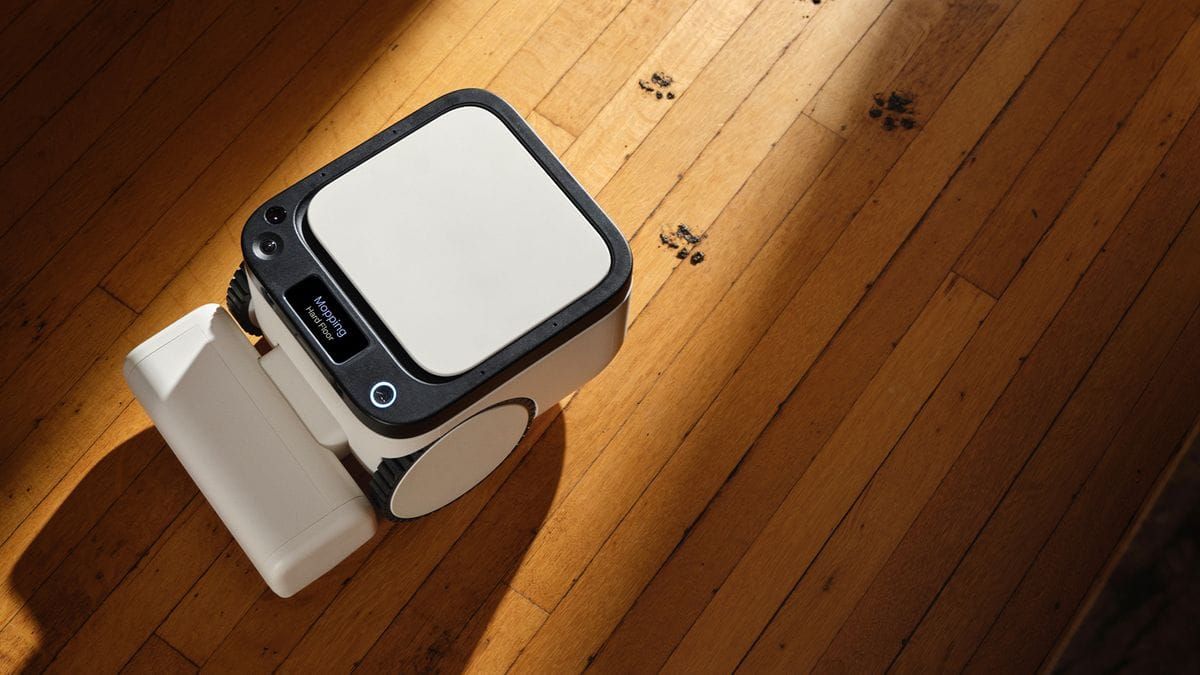
Matic has added voice and gesture controls to its home-cleaning robot, allowing a spoken command paired with a pointing gesture to direct the machine to a specific spot on the floor. Saying "Hey Matic, clean this" while pointing at a spill directs the robot to that exact area without opening the app, and the company reports support for 75 languages.
The capability sits on the perception stack Matic has been building since 2017. Five RGB-IR cameras feed an onboard NVIDIA computer that handles mapping, navigation, and object recognition locally. To resolve a command like "clean this", the system has to find the arm in frame, project where it is aimed, and match that direction against objects already held in its 3D model of the room. Matic states that raw camera footage is discarded in real time, that nothing is uploaded to a server, and that the robot can be set up without an internet connection.
That same vision layer shapes how the robot cleans. It identifies furniture, rugs, wires, toys, pets, and floor types, then adjusts brush speed, suction, airflow, mop pressure, and movement pattern based on what it sees. The 3D map is rebuilt continuously as furniture moves or people walk through, so a rearranged room registers as an update. Matic vacuums hard floors and rugs first and mops hard floors second, switching between the two on its own, and navigates in complete darkness using infrared. Waste and dirty water both collect in a sealed HEPA bag, where an absorbent powder gels the liquids, eliminating the need for a dirty water tank. The company lists 55 decibels while vacuuming and describes the robot as quieter than a conversation.
Matic sells directly in the United States for $ 1,245 for one robot and one dock, with a one-year warranty and a six-month return window. Every unit is assembled and quality-checked in Mountain View, California.
Learn more about Matic
The company operates as Matician and was founded by Navneet Dalal and Mehul Nariyawala, who met at Like.com, an early visual search company acquired by Google, and later built Flutter, a hand-gesture detection product that Google also acquired. Matic came out of stealth in 2023 with roughly $30 million in funding and a stated position that indoor robots could run on cameras alone, with all processing on the edge device. Voice and gesture control follows Apple Home and Google Home integrations that shipped earlier this year, and reflects the founders' long-running argument that a machine should take direction the way a person in the room would.


