

Meta has released Muse Glimmer, a 30-billion-parameter open-weight model built for always-on agents on a Mac or PC with a single consumer GPU. The model comes from Meta Superintelligence Labs, carries a permissive Apache 2.0 license, and is available now on HuggingFace. It targets developers building local agents, coding tools, function-calling systems, and model-based evaluation without relying on a constant network connection.
Introducing Muse Glimmer, an open-weight 30B-parameter model optimized for local, always-on agent workflows.
— AI at Meta (@AIatMeta) August 10, 2026
Muse Glimmer delivers strong performance on key agentic use cases and benchmarks compared with leading models in its size category, and is designed to run entirely on… pic.twitter.com/mI4z91GPnE
Muse Glimmer is trained for end-to-end task completion, precise tool calls, multi-step reasoning, and recovery when a tool fails. A dedicated perception encoder lets it process interleaved text and images, including screenshots, charts, and documents. It also supports more than 100 languages, selectable reasoning strengths, and agent scaffolds such as OpenClaw.
2/ just like much larger models, muse glimmer can operate as a fully capable agent via planning, tool calls, checking its own results, and failure recovery. pic.twitter.com/CMnroWLTe8
— Alexandr Wang (@alexandr_wang) August 10, 2026
Meta designed the model around the memory and compute limits of consumer hardware. Its training used logit distillation from Muse Spark outputs, followed by longer-context agent data, supervised fine-tuning, on-policy distillation, and reinforcement learning across general, reasoning, coding, and agent tasks. Meta says the model was evaluated under its Advanced AI Scaling Framework before the open-weight release.
A full-precision version would need more than 55 GB of memory. Quantization reduces the language model to under 20 GB, leaving room in a 24 GB or 32 GB memory envelope for its working memory, KV cache, image encoder, and speculative-decoding drafter. That lightweight DFlash-based companion proposes blocks of tokens that the main model verifies in parallel. Meta reports decode-speed gains of 3.1 times on an RTX 5090, 1.8 times on an M5 Max, and 1.5 times on an M4 Max for its K-Quant-17GB setup.
Today we're also opening the weights for Muse Glimmer, a great 30B parameter dense model that can run locally. Soon we'll also release the weights for Muse Spark 1.2, our latest foundation model. Meta is a strong supporter of open source and I'm proud of these releases. Congrats…
— Mark Zuckerberg (@finkd) August 10, 2026
Meta positions Muse Glimmer against Gemma4-31B and Qwen3.6-27B, reporting strong results for its size across agentic and general language-model benchmarks. The model is intended for local work that can continue without cloud infrastructure, while still supporting deployment through larger serving stacks.
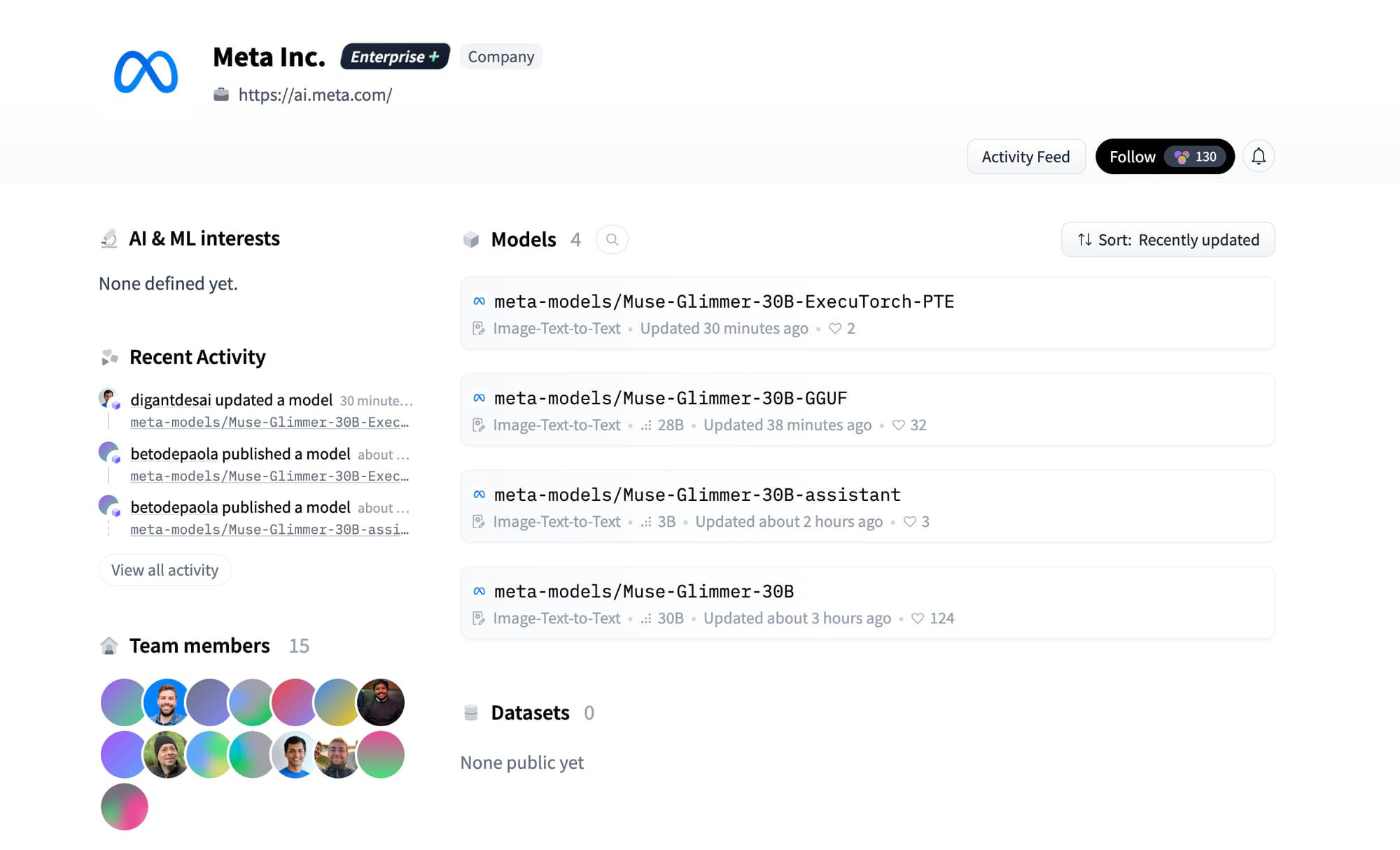
Weights and developer documentation are available now. Optimized support for llama.cpp, MLX, and ExecuTorch is due in the coming days, alongside planned access through Ollama, LM Studio, Unsloth, vLLM, SGLang, Together AI, Fireworks AI, and OpenRouter. Meta is also working with AMD, Arm, Dell, Intel, and NVIDIA on device-level optimization, extending its open AI research into local agent systems.