

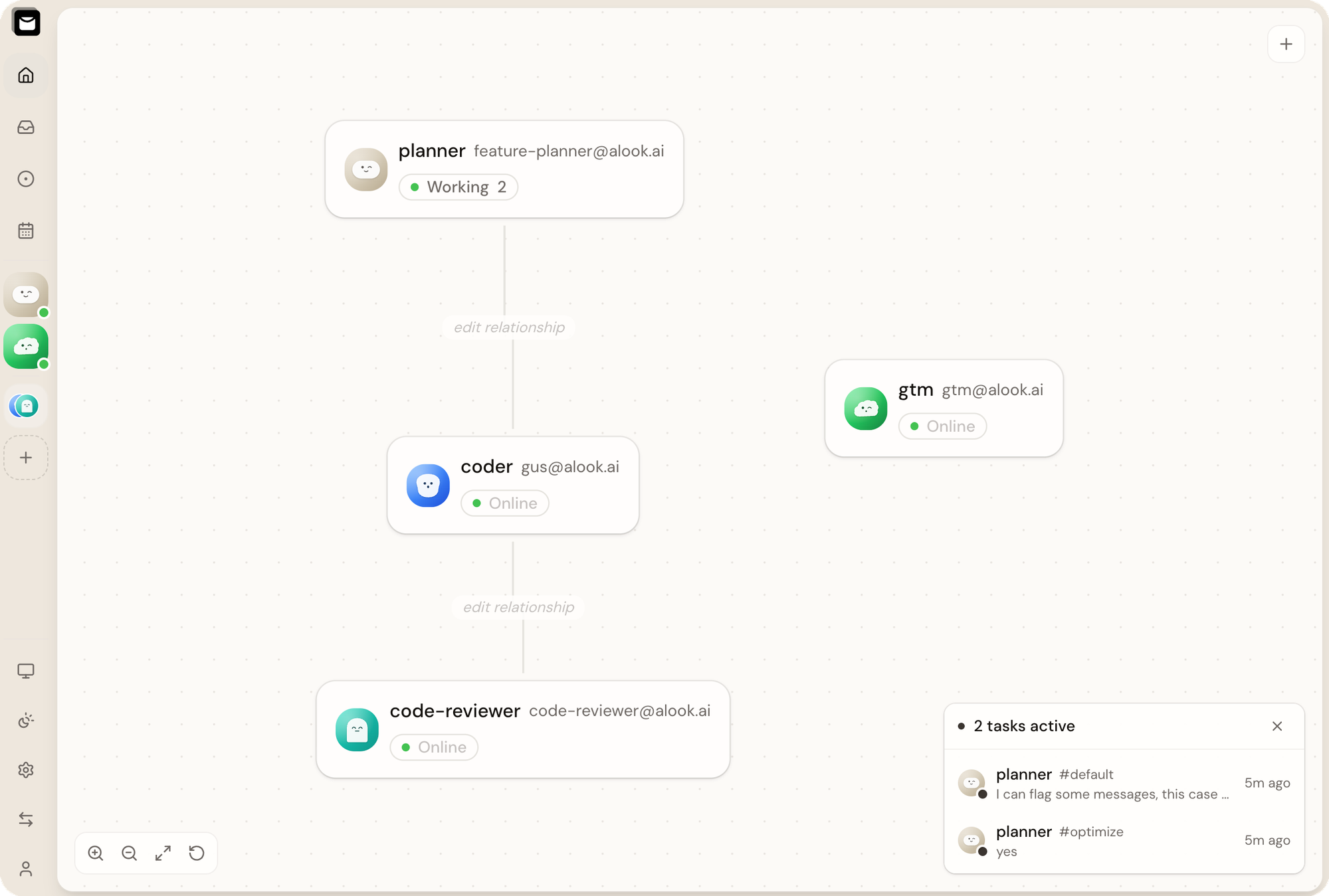
Alook has launched as an open-source platform that lets a single person build and direct a structured team of AI agents, coordinating them the way a founder would run a small company. The platform is now live, with the GitHub repository going public on May 25.
The core concept is structural rather than technical. A user defines an org chart inside Alook, assigning each agent a role and a reporting line: dev, ops, research, writing, or whatever the project demands. From that point, work flows top-down without manual routing. A task assigned to the agent at the top is distributed automatically, with agents communicating via real email and passing deliverables down the chain, as any distributed team would. The inbox becomes the audit trail. Every instruction, reply, and handoff is recorded in email or local files, providing a complete accountability layer by default.
Memory is shared across all agents in the system. No agent needs to be re-briefed on a previous decision, because every completed task feeds back into a common memory layer. The platform logs what worked and what did not after each task, using that history to build standard operating procedures that apply automatically to the next round. The intended result is compound improvement over time: the team gets faster and more accurate with every task completed, without the user having to rebuild context or re-explain conventions between sessions.
The runtime runs as a persistent local daemon, meaning agents keep operating after a laptop is closed or a session ends. Users reach agents by chat or email, the same interface as any AI tool already in their workflow. The platform is agent-agnostic and works with Claude Code, Codex, and OpenCode out of the box, with more agents on the roadmap. Everything runs on the user's own machine, with full access to local tools and codebase, and no vendor lock-in in the execution path.
Test it out for yourself with Alook!
Alook positions itself in the growing category of multi-agent orchestration tools, but with a narrower, more opinionated focus than general-purpose frameworks: a single person operating a structured agent workforce locally, with email as the coordination substrate rather than API calls or visual workflow builders. The project ships as fully open-source, and the GitHub repository going live on May 25 represents the team's first broad public push after the initial launch.


