

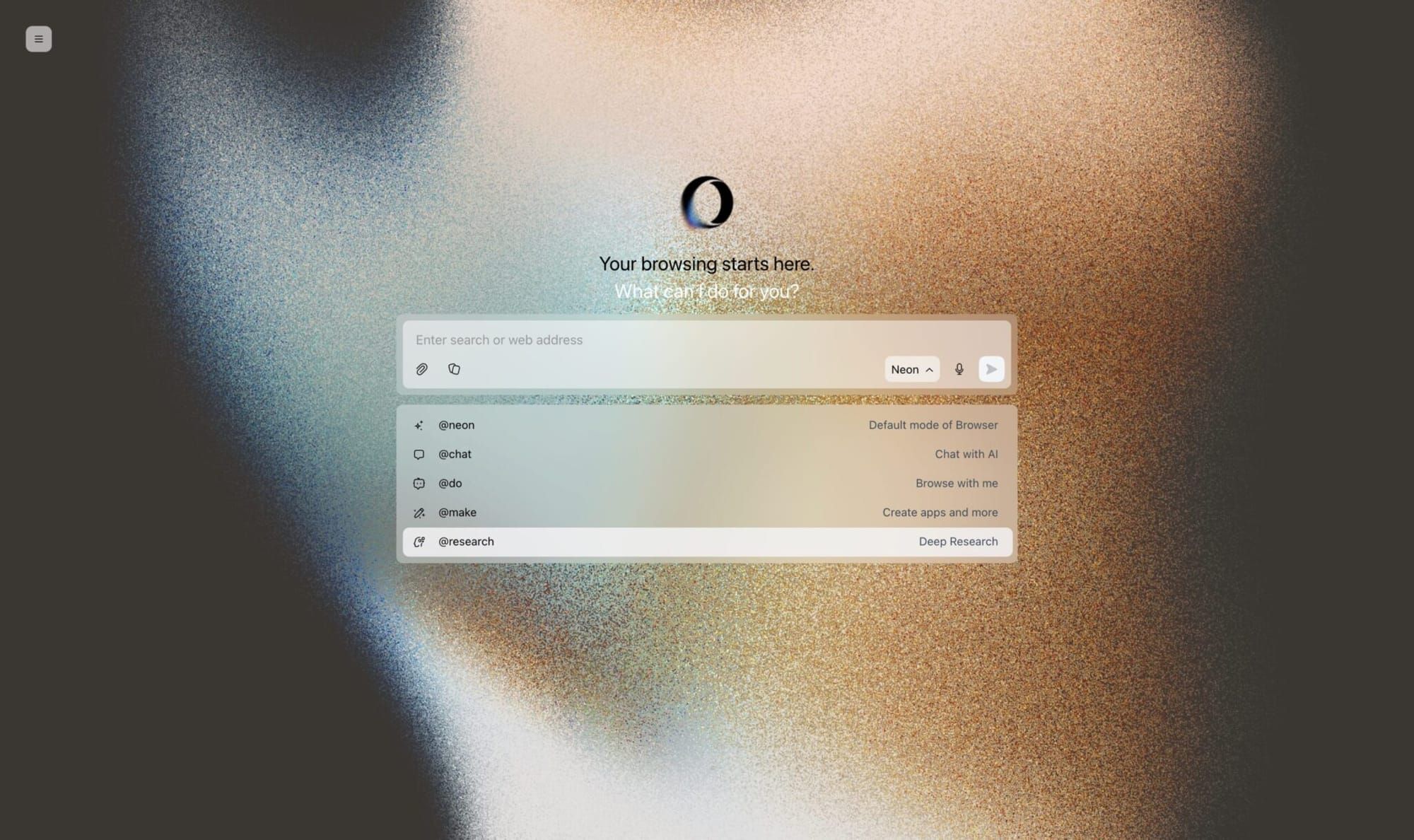
Opera has officially launched the Opera Deep Research Agent (ODRA) for all Opera Neon founders, marking a new phase in browser-based research tools. ODRA is integrated directly into the Opera Neon browser and is now accessible to anyone with founder access. This AI agent distinguishes itself by performing parallel multi-agent reasoning, using multiple large language models, such as GPT and Gemini, coordinated through Opera’s proprietary AI Engine. Unlike standard AI search tools that rely on summarization, ODRA synthesizes, evaluates, and compares information across sources, generating structured reports complete with references and quality checks through the RACE framework for factual grounding.
Opera launched Opera Deep Research Agent (ODRA) for in-depth research and analysis. Deep Research is now available on the Opera Neon browser. https://t.co/X6nJqcFebE pic.twitter.com/SzjEETo0Hx
— TestingCatalog News 🗞 (@testingcatalog) October 31, 2025
ODRA's target audience consists of professionals, researchers, and power users who need comprehensive reports and source validation beyond basic web searches. The tool is immediately available for Opera Neon founders, with a waitlist option for new users. Early feedback from the founder community highlights the value of browser-native, in-depth research capabilities, with some users noting the convenience of exporting reports as PDFs for offline use or sharing. Compared to previous browser AI integrations, ODRA’s LLM-agnostic architecture and multi-model approach are seen as setting a new standard in research accuracy and completeness.
Opera’s commitment to making browsing a hub for agentic AI tools is reflected in the deployment of ODRA. As the company continues developing Opera Neon as a platform with multiple AI agents, this release reinforces Opera’s focus on advanced AI-driven productivity within a unified browser environment.


