
Microsoft has launched Microsoft-Decision-1, a purpose-built model for fast decision scoring that produces structured choices software can act on immediately. It is available now in Microsoft Foundry and is due on OpenRouter soon. The model targets developers building routing, classification, prioritization, verification, workflow control, agent controls, data labeling, AI judging, search relevance, safety screening, computer use, robotics, and scientific discovery systems.
Introducing Microsoft-Decision-1, our new model for fast decision-making.
— Satya Nadella (@satyanadella) October 9, 2026
It delivers top performance on structured decision tasks, outperforming both LLMs and other decision models in latency and quality.
We’re already testing it across Microsoft for everything from incident… pic.twitter.com/M3fAOD90r6
Rather than generating open-ended text, Microsoft-Decision-1 takes a fixed set of options and returns a calibrated probability for each through a structured API call. It supports yes/no, multiple-choice and rating options, along with rubric-based grading of AI responses and agent actions. Microsoft post-trained Qwen3.5-9B for single-pass scoring and plans to rebase the system on other models, including Microsoft AI and OpenAI technology.
Microsoft says the model achieved the highest accuracy in a 36-benchmark evaluation covering nearly 150,000 questions withheld from training. In the company’s tests, it was 4.5 times faster than runner-up Quyet-1.0-Large and 35 times faster than GPT-6 Sol at P50 latency. Across eight perturbations of equivalent requests, its decision changed 1.3% of the time on average, with no flips when option descriptions were paraphrased or options were reversed or shuffled. Safety testing covered 5,250 requests across 11 benchmarks involving harmful content, jailbreaks and prompt injection.
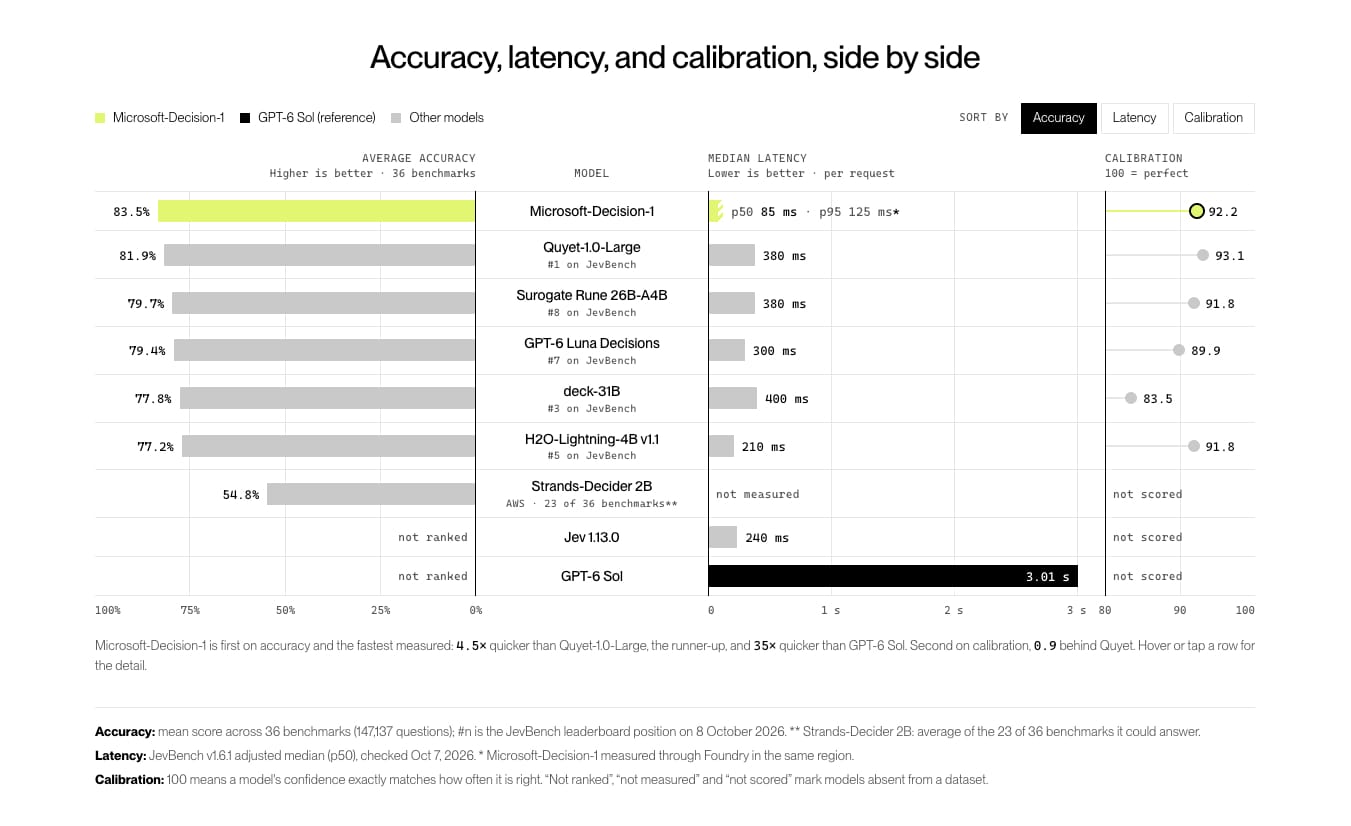
Internal trials put the model into practical workflows. Xbox Research used it to label more than 10,000 feedback items and reported quality competitive with GPT-6 Sol while running over 14 times faster and costing 200 times less. The Copilot team found it competitive with GPT-5.6 Luna and 100 times faster. Microsoft also reports gains in incident knowledge retrieval and scientific replanning, where scoring was 46 times more consistent than an LLM-based approach and produced nearly fourfold faster adaptive replanning.
Pricing starts at $0.042 per million input tokens, with output tokens free. Microsoft is positioning the model as a low-cost control layer for agentic systems, where confidence scores can determine whether software acts, defers, retries, escalates or hands work to a model, tool or person.
Sources and related context
- Microsoft-Decision-1 in the Microsoft Foundry catalog: Supports: The official catalog confirms general availability, Qwen3.5-9B post-training, and calibrated probability scoring for fixed answer options.
- Qwen3.5-9B official model card: Related context: The model card describes the open-weight nine-billion-parameter model that Microsoft post-trained for Decision-1.