
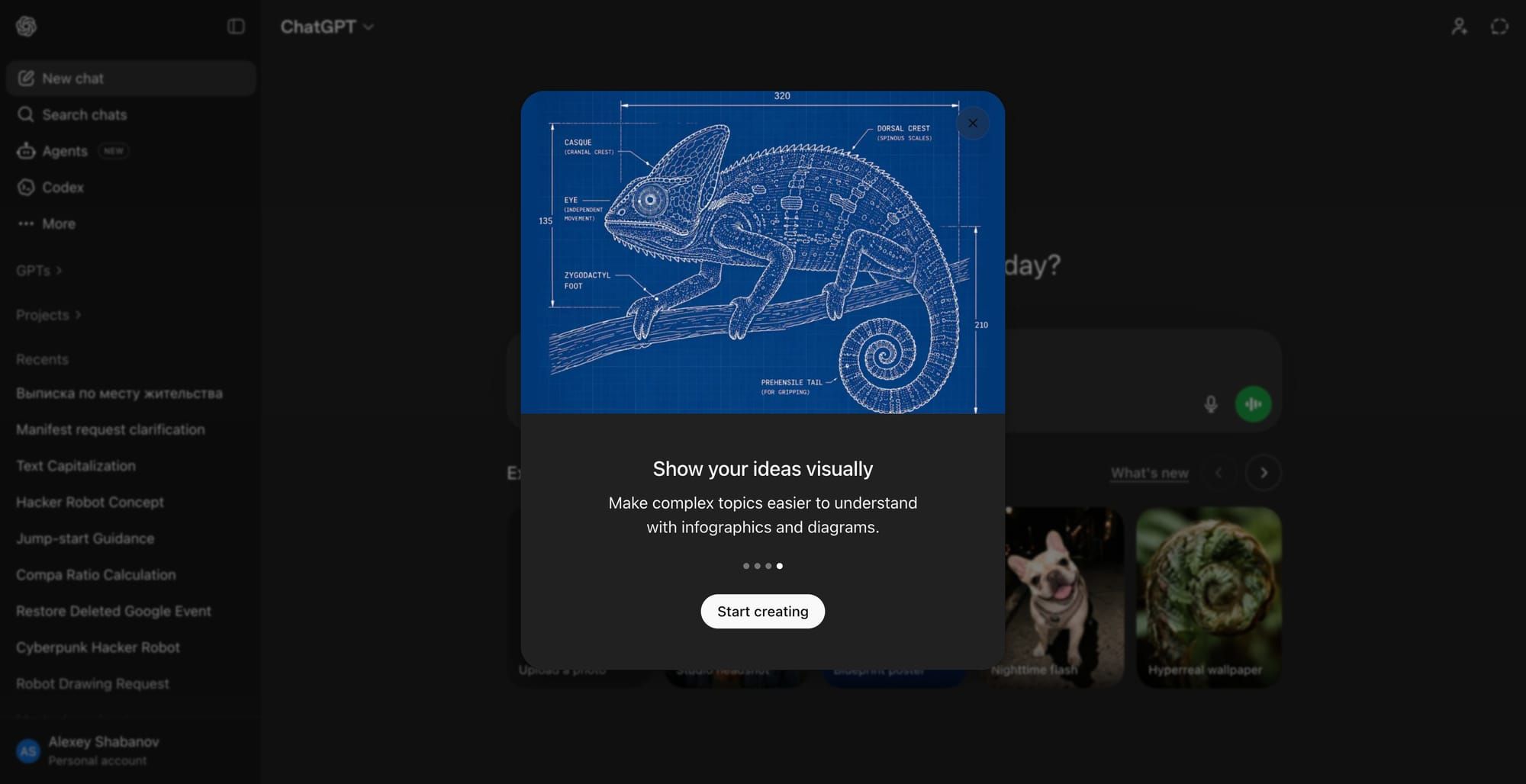
OpenAI officially launched ChatGPT Images 2.0 on April 21, 2026, marking the arrival of a model that had been tracked through LM Arena since December 2025 under codenames like Chestnut, Hazelnut, and more recently packingtape-alpha, maskingtape-alpha, and gaffertape-alpha. The release, available as gpt-image-2 through the API and rolled out across ChatGPT, Codex, and business surfaces, confirms many of the capabilities hinted at during months of silent evaluations on the arena leaderboard.
Introducing ChatGPT Images 2.0
— OpenAI (@OpenAI) April 21, 2026
A state-of-the-art image model that can take on complex visual tasks and produce precise, immediately usable visuals, with sharper editing, richer layouts, and thinking-level intelligence.
Video made with ChatGPT Images pic.twitter.com/3aWfXakrcR
The model ships with two operating modes - Instant and Thinking, with the latter able to reason through prompts, browse the web for references, and verify its own outputs before drawing. Batch generation supports up to eight images in one pass with character and style consistency, opening the door to manga pages, storyboards, comic strips, and multi-scene marketing kits. Aspect ratios now stretch from 3:1 wide to 1:3 tall, and OpenAI officially advertises up to 2K resolution. In practice, however, the canvas interface permits tile sizes of 3840×2160, meaning 4K outputs are already reachable through the quality-high setting, a detail not surfaced in the announcement itself.
Text rendering, historically the Achilles heel of diffusion-based image models, appears to take a genuine step forward. Dense infographics, labeled maps, museum-style exhibit timelines, and scientific charts were front and center in the launch reel, alongside photorealistic editorial spreads. Non-Latin scripts including Japanese, Chinese, Hindi, and Bengali are now supported at a quality OpenAI positions as category-leading, directly targeting markets where Google's Nano Banana and Imagen lineup and ByteDance's Seedream have dominated.
Arena Trends: Text-to-Image, Jan 2026 – Apr 2026
— Arena.ai (@arena) April 21, 2026
For most of the year, @GoogleDeepMind and @OpenAI traded the top spot within a tight margin - GPT-Image vs. Nano Banana - with the rest of the field clustered below 1,200.
Today, GPT-Image-2 breaks away with a score of 1,512, 242… https://t.co/bVKuFGcLAr pic.twitter.com/yfO6w0x3Ka
Free and Go tiers receive Instant mode, while Plus, Pro, and Business subscribers unlock Thinking-powered workflows and more advanced outputs. Integration into Codex is the strategically loaded move here: designers and developers can now generate UI mocks, prototypes, and visual assets inside the same agentic workspace that handles coding, slides, and browser automation, using a single ChatGPT subscription rather than a separate API key. The December 2025 knowledge cutoff, shared across the Images 2.0 stack, should also make the model more reliable for explainers and educational graphics where factual grounding matters as much as aesthetics. With DALL·E 2 and 3 set to retire on May 12, the launch also closes a commercial gap left by those sunsets and repositions image generation as a core interface rather than a side feature.


