
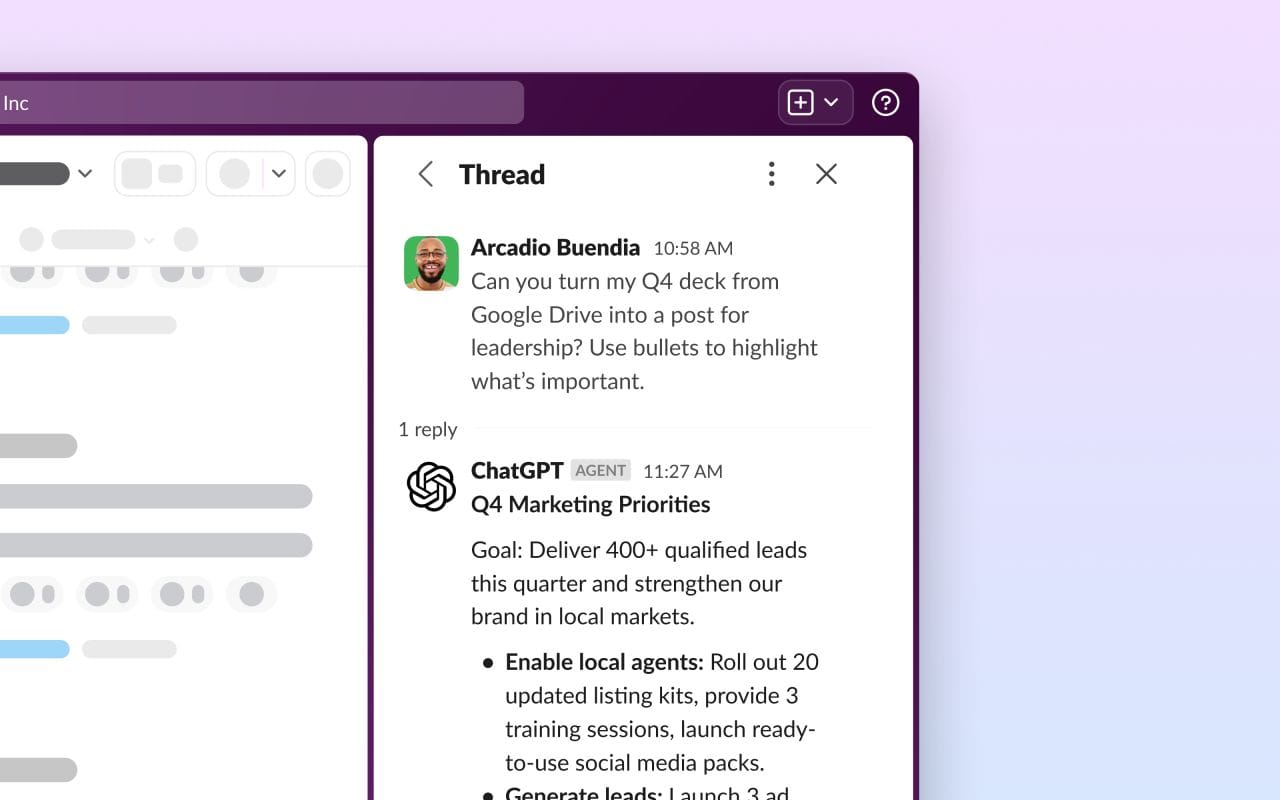
Slack has introduced a comprehensive update, positioning itself as the central agentic operating system for enterprises. This release targets enterprise customers, particularly those already using Salesforce, and is immediately available to Salesforce clients globally, with early features accessible to a wider business audience over time. The rollout brings conversational CRM experiences from Agentforce Sales, IT, and HR Service, as well as Tableau, directly into Slack, enabling users to access, query, and act on customer data, IT requests, and HR tasks through natural language within their workflow.
Welcome to the agentic era of work. ✨
— Slack (@SlackHQ) October 13, 2025
At Dreamforce, we're unveiling new Slack innovations that unite your people, agents, data, AI, and apps in one place. Get ready for:
🔹 A personalized AI companion in Slack
🔹 An always-on agent dedicated to your team’s questions
🔹… pic.twitter.com/CCoubEJCeu
The upgraded Slackbot now functions as a personalized AI assistant, offering contextual insights across integrated tools like Google Drive, Salesforce, and OneDrive. Channel Expert, another AI-powered agent, provides instant, in-channel answers based on company-specific knowledge, reducing repetitive queries for subject-matter experts. Technical enhancements include the Real-Time Search API for secure, instant data access, and the Model Context Protocol server, which allows developers and partners, including OpenAI, Anthropic, Google, Perplexity, and others, to create context-aware AI agents natively within Slack. This integration brings together workflow automation, enterprise search, and intelligent assistance in a single platform.
The next evolution of the Slack platform is here. 🔮
— Slack (@SlackHQ) October 13, 2025
Now you can build and use powerful, context-aware AI apps and agents that securely connect to your conversational data — right in your flow of work. ⚙️
Explore innovations from industry leaders like @OpenAI, @AnthropicAI,… pic.twitter.com/AMyS9Rn1re
Slack, acquired by Salesforce in 2021, is leveraging this release to unify disparate enterprise tools and foster collaboration between people and AI agents. Early reactions from enterprise customers like Engine indicate increased operational efficiency and the ability to scale automation. The updated platform is poised to redefine how teams interact with business systems, making Slack the primary interface for conversational, agent-driven work across organizations.


