
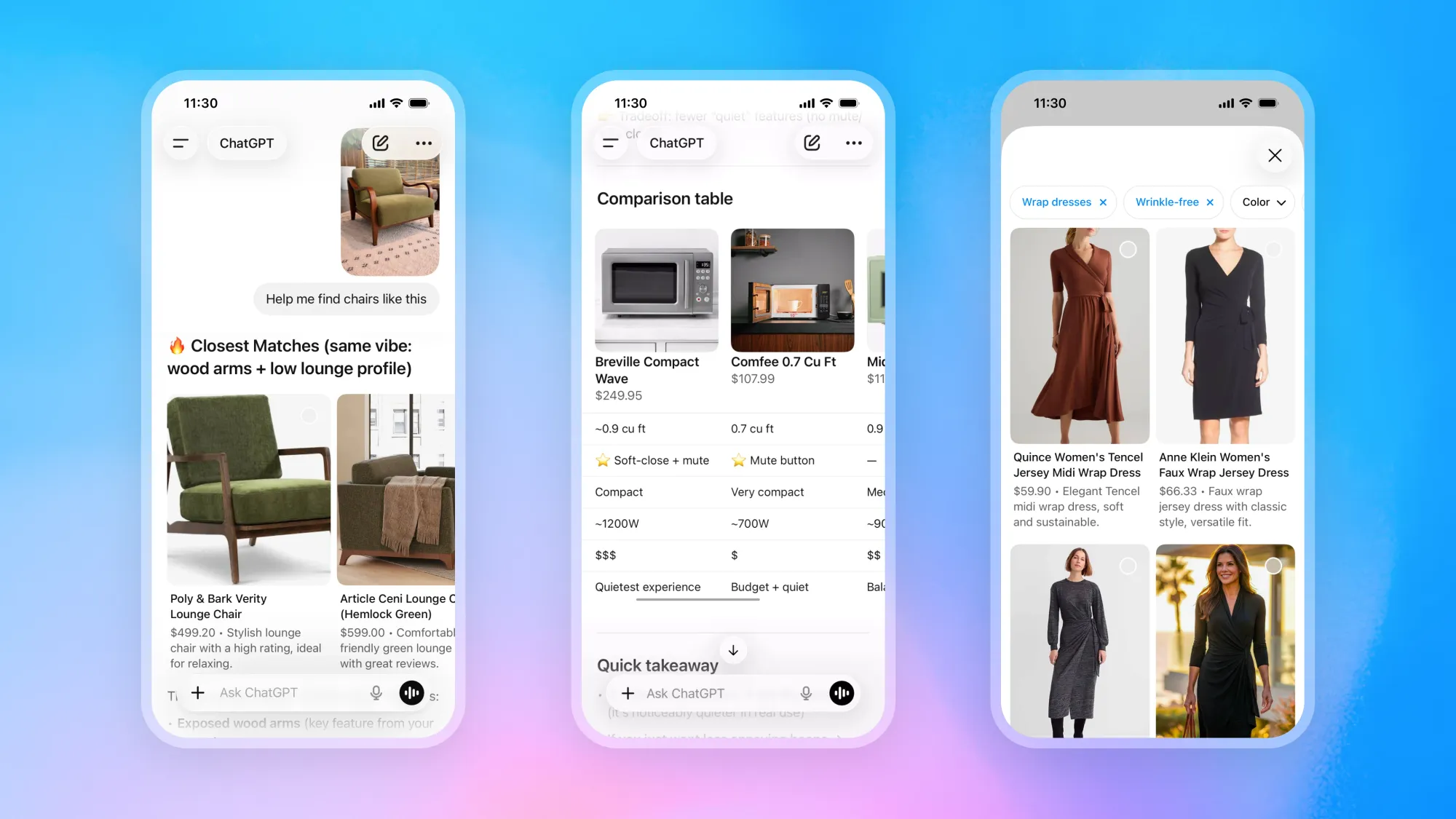
OpenAI is advancing ChatGPT's capabilities in the shopping domain with a new product discovery experience that transforms the chatbot into a more visual recommendation and comparison tool. Users can now explore product cards, compare items side by side, examine prices, reviews, and features, and even use uploaded images as inspiration when searching for similar products.
The rollout is already in progress for ChatGPT Free, Go, Plus, and Pro users, indicating that OpenAI is not restricting this to a small pilot. The company has enhanced speed, relevance, and product coverage, enabling the assistant to present fresher catalog data and help narrow choices within a single thread instead of directing users across multiple tabs and retailer pages. This marks a clear shift in how OpenAI envisions ChatGPT's use: not just as a research assistant, but as a product discovery layer bridging consumers and merchants.
OpenAI is rolling out an upgraded shopping experience on ChatGPT, with more visual enhancements, better product coverage, and more customization options for merchants. https://t.co/gN5LMqyYZy pic.twitter.com/1S5spGidGE
— TestingCatalog News 🗞 (@testingcatalog) March 24, 2026
At the core of this launch is OpenAI’s Agentic Commerce Protocol, or ACP, an open standard designed to allow merchants to feed structured catalog data, promotions, inventory signals, and other commerce metadata directly into ChatGPT. Practically, this provides OpenAI with a framework for displaying products with more complete and current information. OpenAI is also indicating future directions. The company is positioning ACP as the foundation for broader AI commerce flows that could later include personalization, local stock visibility, and delivery timing.
Several major retailers are already integrated into the discovery layer, including Target, Sephora, Nordstrom, Lowe’s, Best Buy, The Home Depot, and Wayfair. Shopify plays a significant role in this expansion. Shopify states that millions of merchants can now be discovered in ChatGPT through Shopify Catalog, without the need for a separate app or manual integration for standard storefront exposure. On mobile, Shopify allows purchases to be completed in an in-app browser, while desktop users are directed to the merchant’s own site. This approach maintains the merchant's control over branding, checkout logic, payment methods, and customer ownership.
OpenAI is also refining its strategy. The company acknowledges that the previous Instant Checkout model lacked flexibility, prompting a shift towards discovery while allowing merchants to retain their own checkout experiences. Simultaneously, OpenAI is leaving room for deeper native integrations through ChatGPT apps. Walmart exemplifies this approach with a customized in-ChatGPT shopping environment on the web that supports account linking, loyalty, and Walmart payments, with iOS and Android app support to follow.
For OpenAI, this initiative is more than just an interface refresh. It is an effort to make ChatGPT the primary platform for users to compare products and to persuade merchants that AI chat can evolve into a genuine acquisition channel rather than merely a source of referrals.


