

TypeSafe AI has emerged from two years of stealth with Jev, its first System One Model, now entering early access as developers are brought off the waitlist. The company positions the model as a fast decision layer for software, trading open-ended text generation for predefined, typed outputs that applications can consume directly.
After co-inventing ChatGPT, I kept asking myself: why have superhuman chat models not led to AGI?
— Diogo Almeida (@CompleteSkeptic) September 15, 2026
I’ve spent the last 2 years in stealth building a new way to train models (RLCD), and a new type of frontier AI model that we are releasing today: Jev
• 20-200x faster
• 40-400x… pic.twitter.com/JSybNG2BKJ
Jev accepts unstructured context, including text and structured program state, then returns probabilistic decisions with confidence scores. Developers define the available choices and output structure in advance. Rather than generating tokens sequentially, the model evaluates decisions in parallel. TypeSafe says schema matching is guaranteed and type errors are mathematically impossible. Its claim that Jev cannot hallucinate applies to the constrained output space, however, and does not mean every factual decision will be correct.
The model is priced at $0.042 per million input tokens, or $42 per billion, with no charge for output tokens. TypeSafe reports end-to-end response times of 70 to 500 milliseconds and says Jev can be 40 to 200 times faster on similarly intelligent System One-shaped queries. Homepage examples show gains of 193.6 times in speed and 444.6 times in cost, though the company says those figures likely sit near the upper end of real-world results and that long-term pricing sustainability remains unproven.
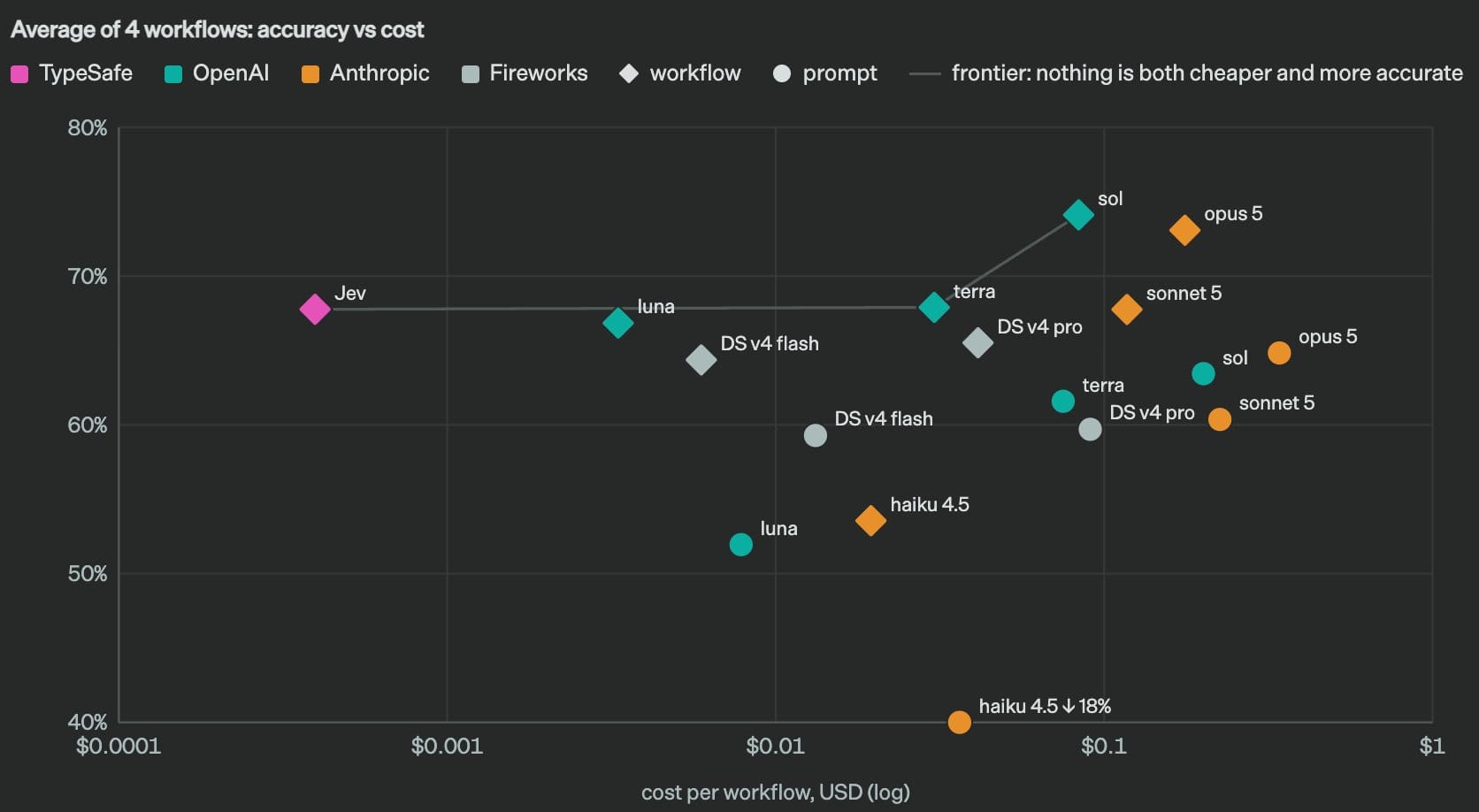
Those comparisons need careful reading. TypeSafe’s workflow evaluations use identical compute graphs and compare outputs against the average probabilities from GPT-6 Astra and Fable 5.1, not ground-truth labels. Four workflows are published, but they were created by the company’s own model-capabilities team, leaving room for selection bias. The LLM baseline also uses TypeSafe’s System One LLM wrapper, which constrains conventional models to compatible structured decisions and may affect speed and cost. Most tests were run from laptops on the US West Coast, where the service is based.
Potential uses include classification, routing, scoring, extraction, branching, large-dataset processing, real-time applications, and guardrails for LLM output. Demos span Doom, using structured state plus text rather than images, and Wikiracing. Jev can directly handle up to 255 choices; larger choice sets use one stage to score candidates independently and another to select among them. TypeSafe also notes that its Wikiracing comparisons mostly use non-reasoning LLM modes, making those rivals look weaker than they might with reasoning enabled.
Jev combines a new model architecture, a parallel sampler, and Reinforcement Learning for Calibrated Decisions. Founder Diogo Almeida says his earlier work at OpenAI covered instruction following and conversational model methods that helped lead to ChatGPT. With early access opening, TypeSafe is betting that many software tasks need a fast, bounded decision engine more than another system that writes strings.


