
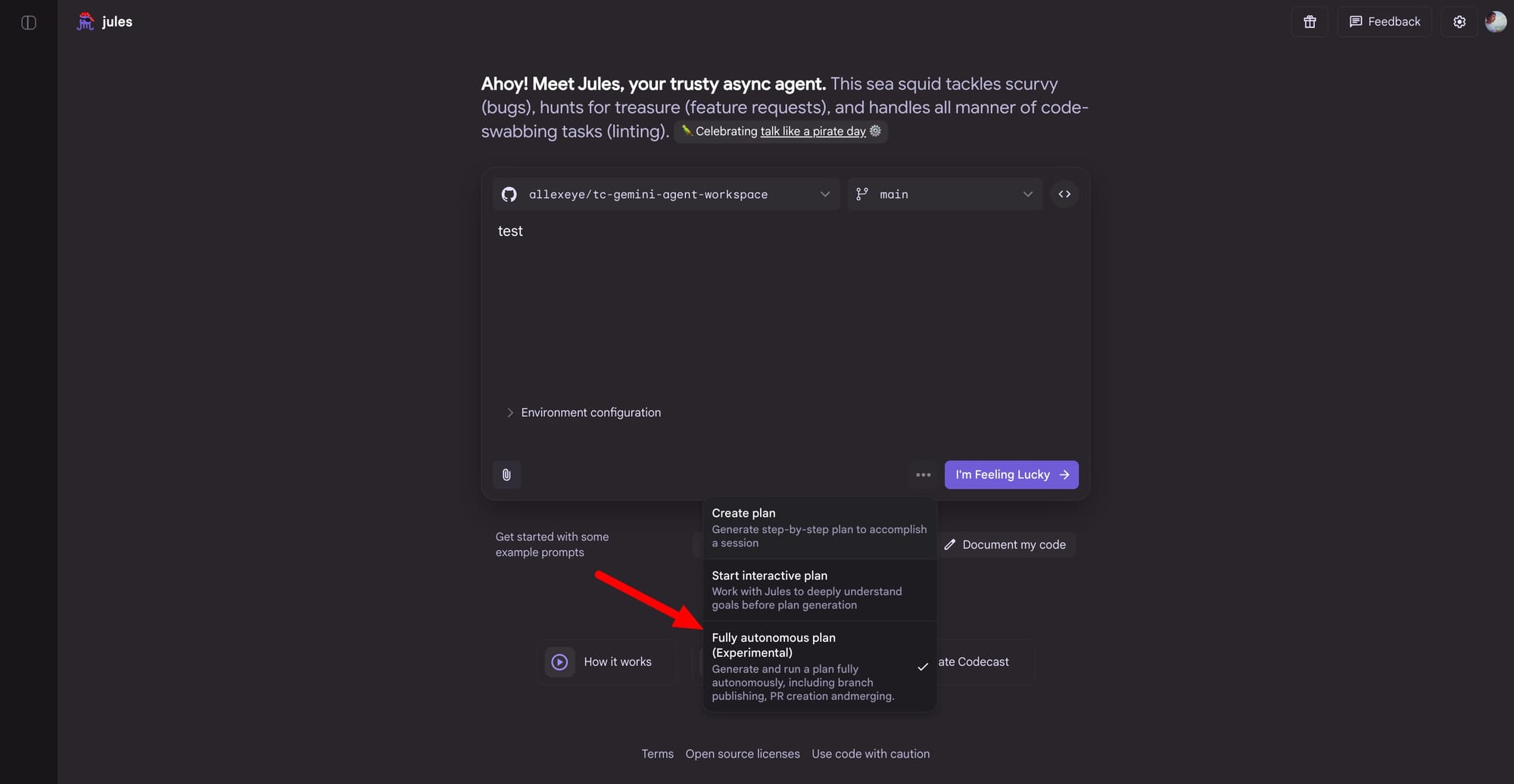
Google continues to expand the capabilities of Jules, its software engineering agent, with a steady rollout of new features aimed at automating developer workflows. Among the most notable additions currently in experimental testing is the “Fully Autonomous Plan” option found under Plan Creation. This mode signals a significant shift: Jules will independently handle all phases of a software engineering task, including creating branches, executing plans, and merging pull requests, essentially operating without human intervention once the task is launched. The UI even references the classic “I’m Feeling Lucky” button from Google Search, hinting at a one-click, high-trust automation mode that some might see as a YOLO-style workflow.
Imagine running the "make it better" prompt on a loop via Jules that is connected to a full CICD and deploys to prod on PR merge.
The primary audience for this feature would likely be advanced developers and teams who need rapid prototyping or wish to automate routine project bootstrapping, particularly when generating single-use applications or initializing complex repositories. The risks are also acknowledged: with Jules acting autonomously, there is a chance that the resulting pull requests might need to be reverted if outcomes don’t align with expectations. This self-reverting safety net mirrors broader trends in agentic automation, where speed is prioritized but oversight remains essential.
These autonomous features are still under a feature flag, suggesting internal testing and limited rollout. There’s speculation in the community about whether this mode could debut widely alongside the anticipated Gemini 3 update, reflecting Google’s broader push into agent-first workflows powered by its latest AI models. For now, “Fully Autonomous Plan” positions Jules as a strong contender for teams looking to push automation boundaries within software engineering, though its impact will depend on how robust and safe the underlying agent proves to be during real-world usage.
From a company strategy perspective, Google’s rapid expansion of Jules aligns with its goal to make developer agents a core part of its cloud and AI tooling portfolio. By offering deeper autonomy—while keeping experimental flags in place, Google can observe real-world adoption patterns and fine-tune these capabilities ahead of a wider rollout.


