

ClickUp has launched Brain², a full relaunch of ClickUp Brain that transforms the company's built-in AI from an assistant into a context-aware coworker capable of acting across an entire workspace. The release positions Brain as a system that manages the work rather than merely answering questions about it, with every major frontier model available under one subscription and grounded in a team's own data from the first prompt.
The 100x org went viral. Half the internet hated it. The other half was curious.
— Zeb Evans (@DJ_CURFEW) June 23, 2026
One month later: output is up. productivity is spiking. we're approaching a 5:1 agent-to-human ratio.
And contrary to popular belief, we're doing the OPPOSITE of tokenmaxxing. We're… pic.twitter.com/MoKZWuJhcR
The central pitch is context. While general-purpose chatbots start each session knowing nothing about a company, Brain² reads tasks, documents, and connected applications in real time and injects that context automatically into whichever model a user selects. Claude, ChatGPT, and Gemini all operate within the same subscription, each with full access to workspace data.
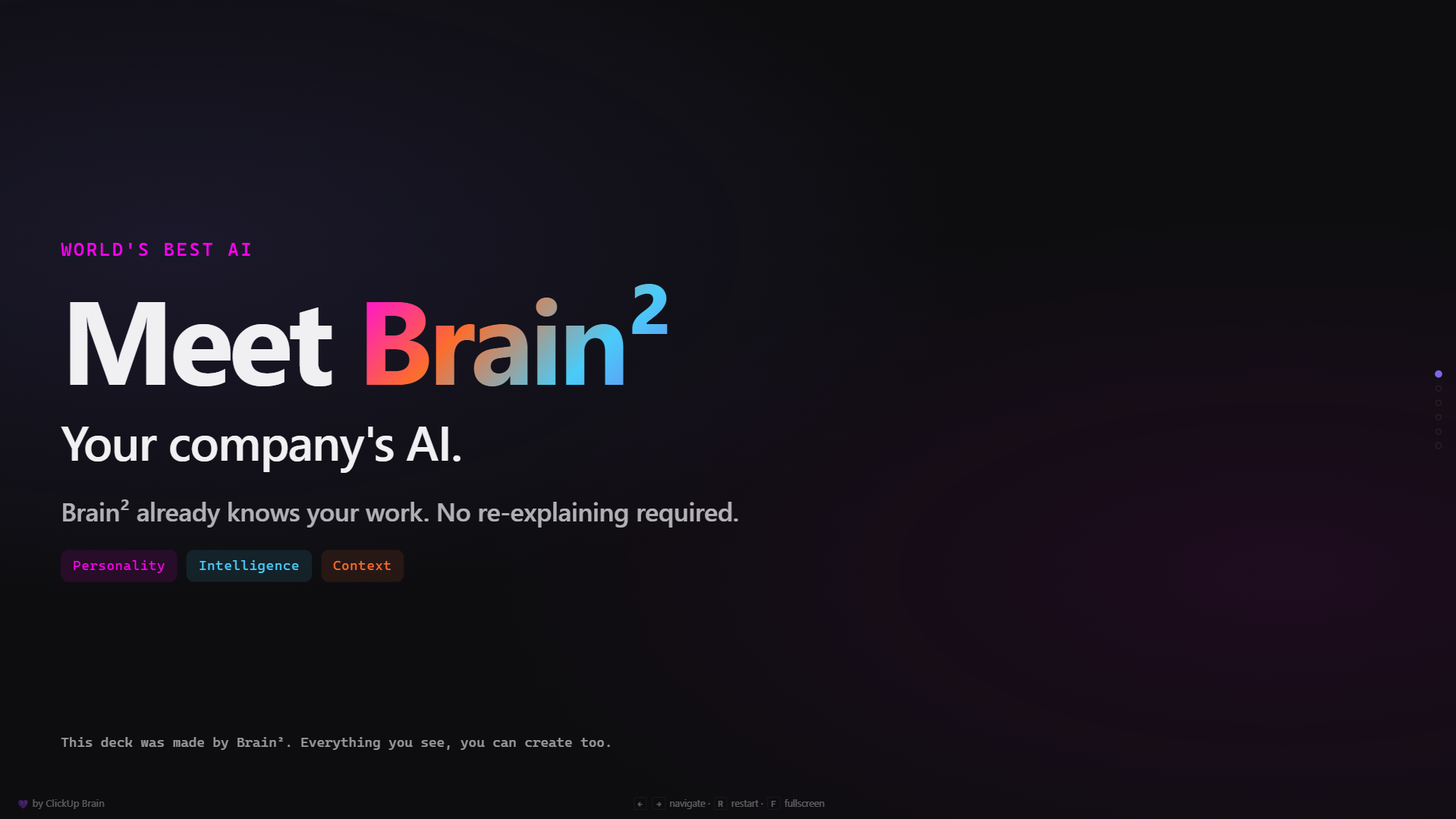
Brain selects the model best suited to each step of a task and can switch between them mid-execution. Founder and chief executive Zeb Evans highlighted the gap, stating that general-purpose AI knows nothing about a user's work, whereas Brain² provides any chosen model full access to the workspace so it can act on it, not just describe it.
ClickUp to add artifacts with Brain2 👀
— 🚨 AI News | TestingCatalog (@testingcatalog) June 20, 2026
> It will be able to create slides, prototypes, websites, or dashboards.
> Brain pulls from workspace context, so the output is built on real project data > Artifacts render inline in the channel and stay fully interactive.
When Brain is… pic.twitter.com/ZZhxDFJFPt
In practice, a user can tag Brain in any task, document, or chat and have it read the full thread, pull from connected tools such as Google Drive, GitHub, and Slack via the Model Context Protocol, and then return a finished deliverable rather than a draft answer.
ClickUp's Brain AI will now be able to create agents on its own!
— 🚨 AI News | TestingCatalog (@testingcatalog) June 21, 2026
> Brain now spots when a task is worth handing off and offers to build a dedicated agent.
> It ships preconfigured, with triggers, rules, and scope already in place.
> Work keeps moving after Brain finishes, with… pic.twitter.com/LdLPP3KhaP
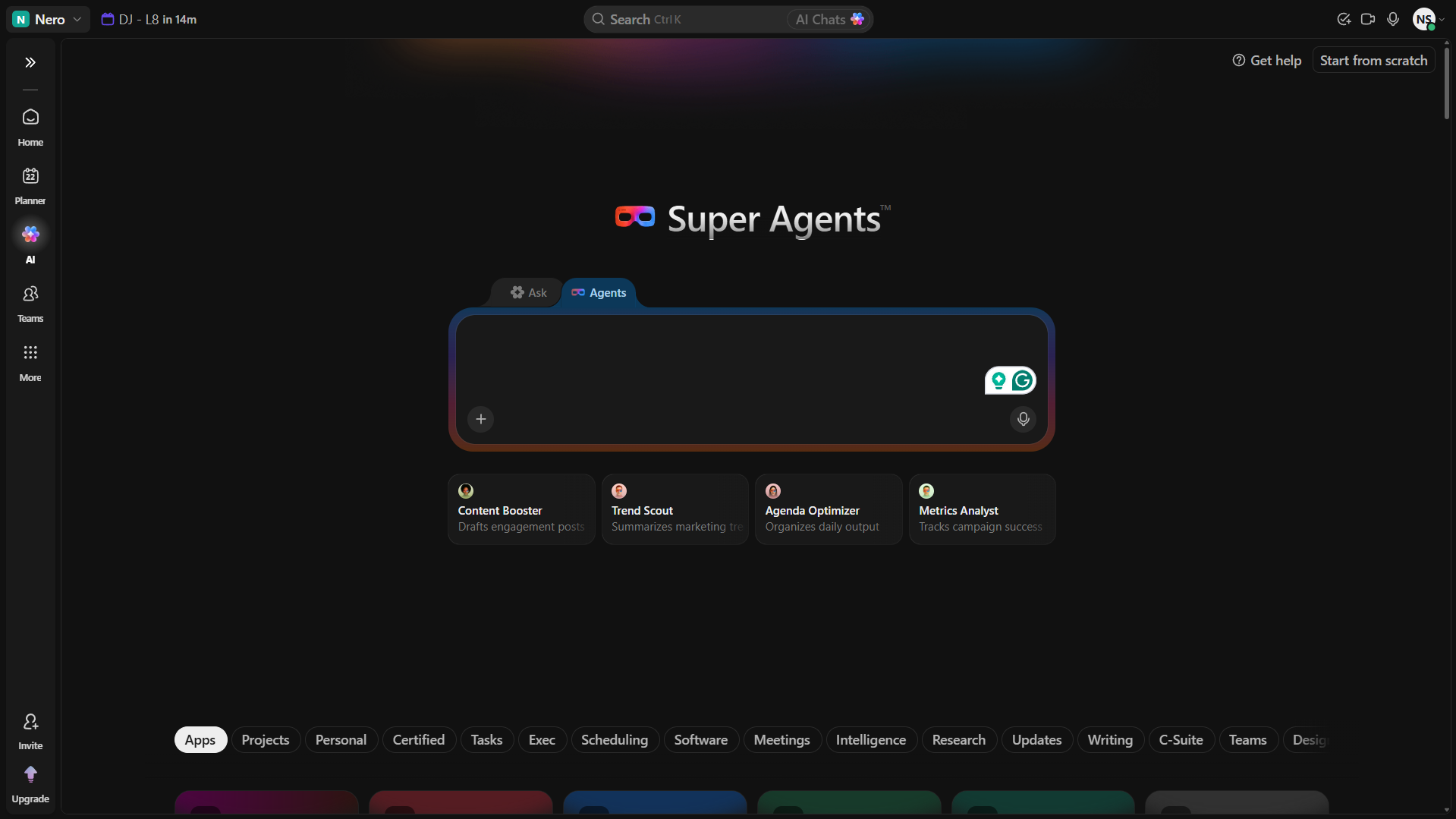
ClickUp demonstrated the system generating a six-page sales deck from a single tagged lead, and slide decks, dashboards, websites, and working code can each be produced from one prompt. The platform also builds Super Agents, custom AI teammates that run workflows around the clock, and maintains persistent memory of preferences, formatting rules, and team shorthand across sessions instead of resetting each time.
The retrieval layer is powered by Qatalog, an enterprise search company ClickUp acquired alongside AI coding startup Codegen to build Brain². Qatalog's ActionQuery engine is permission-aware, ensuring Brain² surfaces only what each person is allowed to see, with what the team describes as zero index lag across more than one hundred integrations.
Brain also references the sources behind each response so its work can be verified, and it includes a system prompt designed to question decisions rather than simply agree with them. ClickUp lists ISO 42001 certification and zero data retention for model training as part of the package.
Start testing Brain² on Clickup!
ClickUp has been advancing into AI over the past two years, raising more than half a billion dollars, and has expressed its intention to go public. Brain² extends that work-management platform into a model-agnostic AI layer that competes with offerings from Notion, Slack, and Asana, and is available on desktop and mobile for teams already working in ClickUp.


