
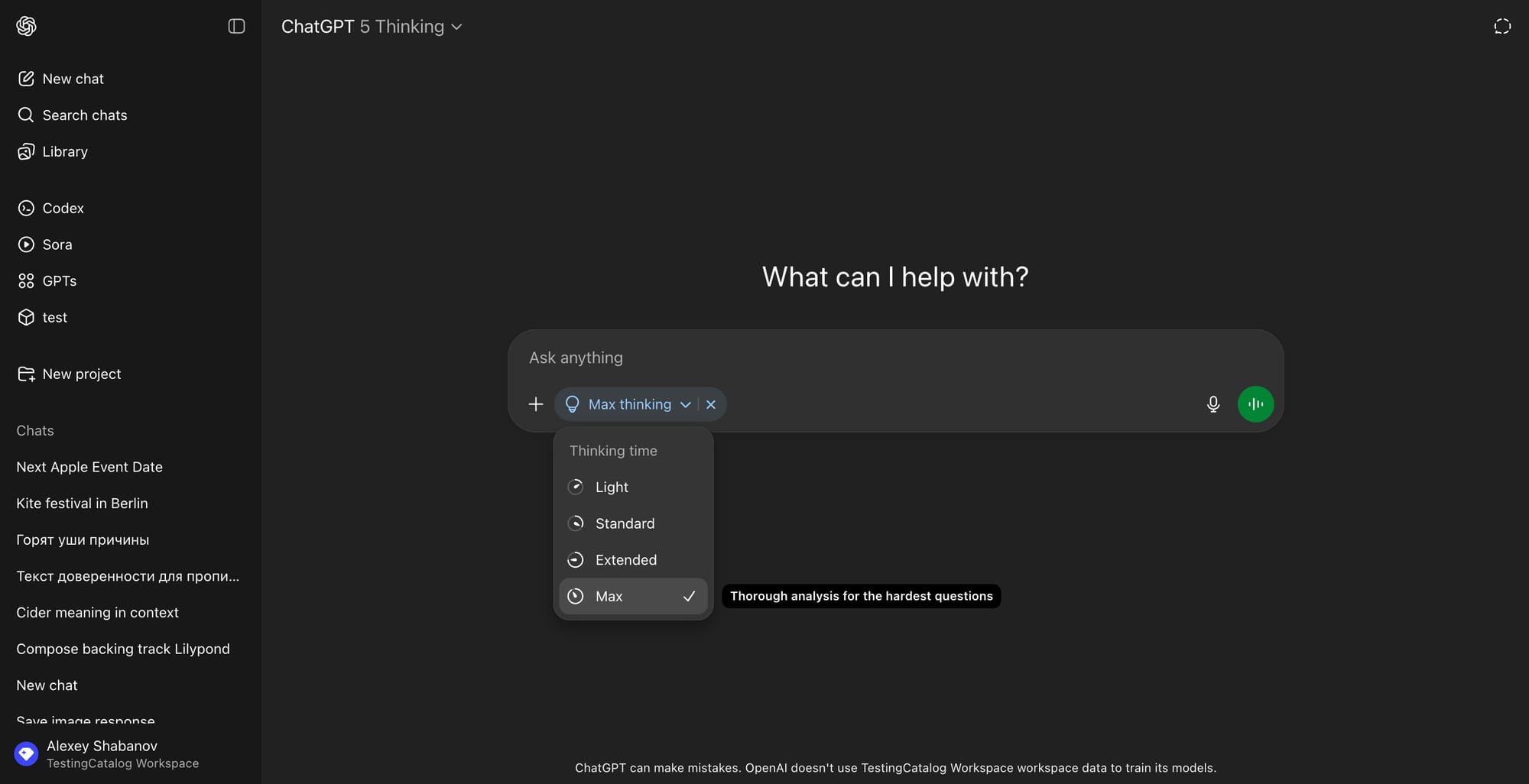
Recent updates in OpenAI’s GPT-5 platform highlight ongoing experimentation with its model and effort selectors, as well as new tools for managing conversation history. These features are currently being tested primarily with Pro and Enterprise users, though some options, like GPT-5 Pro, are also accessible to team plans. The new selector appears to move the choice for “thinking effort” (internally referred to as “juice”) into a more prominent front bar position, making it quicker to adjust. The inclusion of a “max” setting, reportedly capped at 200 juice, signals further granularity in controlling how much computational depth is allocated per task. No official timeline is provided for when (or if) broader access or higher levels will roll out, but such moves typically precede a staged expansion if early feedback is positive.
The new ChatGPT web app version has an updated (hidden) thinking effort picker - Max thinking (200), Extended thinking (48), Standard thinking (18), Light thinking (5)
— Tibor Blaho (@btibor91) August 29, 2025
And a few other related experiments, including showing models in the plus menu, showing the selected model in… pic.twitter.com/onWcBq4Cuw
Alongside this, OpenAI is piloting a branching system for conversations, enabling users to jump back to a previous message and initiate a new conversational path from that point. This could help researchers, power users, and anyone running comparative prompts, as it reduces friction when exploring multiple approaches or when retracing steps is needed due to suboptimal outcomes in one branch. It’s likely these capabilities will surface in the chat UI itself.
"Branch from here" option has been added to the ChatGPT web app in the latest build (hidden/work-in-progress, probably) - allowing branching of a conversation to a new conversation after a response pic.twitter.com/LVM0l2j5eX
— Tibor Blaho (@btibor91) August 27, 2025
These features were surfaced by inspecting new builds, where hints about internal flags and menu changes became evident. OpenAI’s product direction has focused on making advanced model capabilities both powerful and manageable for a wider set of users, especially as GPT-5 rollout on ChatGPT initially faced friction around complexity and transparency. The approach to “thinking effort” selection and conversation branching indicates a response to feedback that demanded more control and clarity without sacrificing usability. For teams leveraging AI in research or production, these upgrades, if released broadly, could streamline prompt design and result-tracking across long or divergent workflows.


