
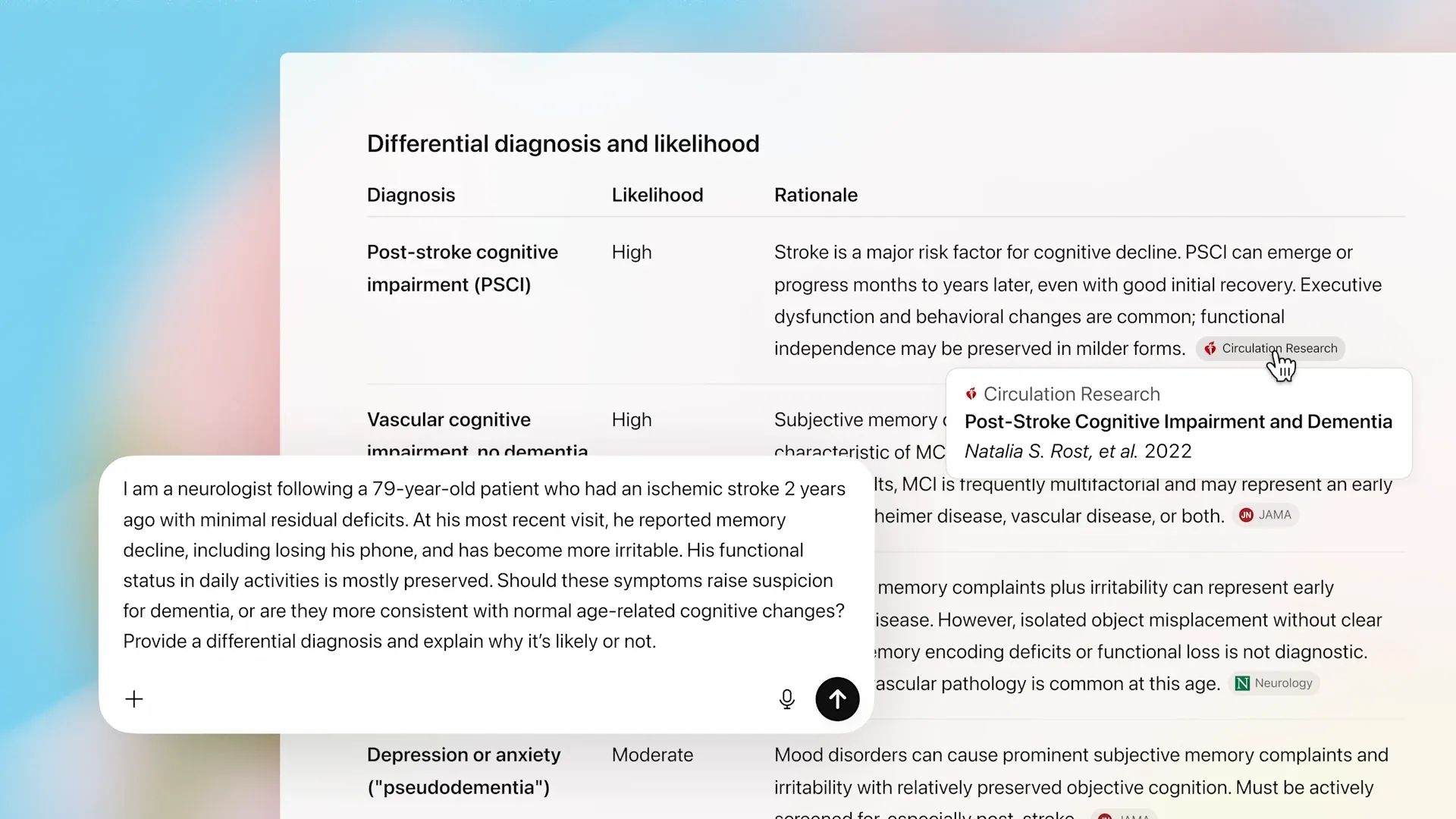
OpenAI has launched “OpenAI for Healthcare,” positioning it as a secure, enterprise-grade set of products for hospitals, health systems, and healthcare builders who want to deploy AI at scale while supporting HIPAA compliance requirements. The rollout starts with ChatGPT for Healthcare, already being deployed across major providers and academic medical centers including AdventHealth, Baylor Scott & White Health, Boston Children’s Hospital, Cedars-Sinai, HCA Healthcare, Memorial Sloan Kettering, Stanford Medicine Children’s Health, and UCSF.
OpenAI launched OpenAI for Healthcare, a set of products supporting HIPAA compliance powered by GPT-5.2 models, including ChatGPT for Healthcare which is already rolling out to leading institutions
— Tibor Blaho (@btibor91) January 8, 2026
- ChatGPT for Healthcare includes medical evidence search with citations from…
ChatGPT for Healthcare is designed around clinical and operational workflows: GPT-5 models tuned for healthcare tasks, evidence retrieval grounded in medical literature and guidelines with transparent source citations, and integrations that can incorporate an institution’s internal policies and care pathways (including enterprise repositories like SharePoint). It also includes reusable templates for common documentation such as discharge summaries, referral letters, and prior authorizations, plus centralized governance features like SAML SSO, SCIM, and role-based access controls. OpenAI says customer content is not used to train models, and highlights options like audit logs, customer-managed encryption keys, data residency, and a Business Associate Agreement.
For developers, OpenAI is framing its API as a healthcare platform layer: access to current models (including GPT-5.2), plus a path to a BAA for eligible customers building chart summarization, care-team coordination, discharge workflows, ambient documentation, and scheduling. Under the hood, OpenAI points to a clinician-led evaluation program with 260+ licensed physicians across 60 countries reviewing 600,000+ model outputs across 30 focus areas, alongside physician red-teaming and benchmarks like HealthBench and GDPval.