
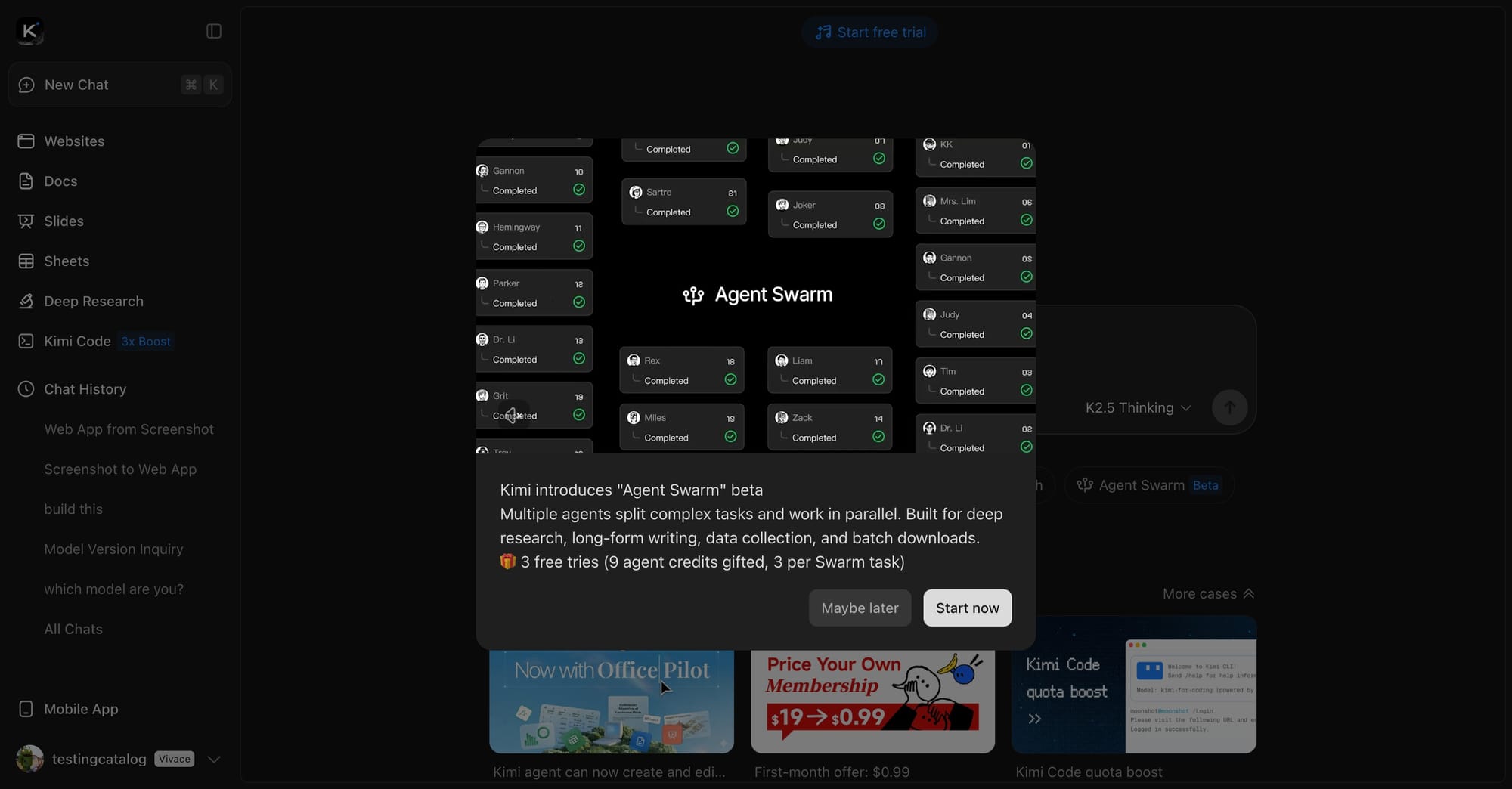
Kimi has unveiled Agent Swarm, a self-organizing AI system that goes beyond the traditional single-agent approach. Rather than relying on one model to process tasks sequentially, Agent Swarm creates an internal organization, autonomously assembling and managing up to 100 specialized sub-agents in parallel for research, analysis, or content generation. This allows it to execute over 1,500 tool calls and deliver results at speeds up to 4.5 times faster than single-agent systems. The feature is currently offered as an early research preview, with continued development planned to enable direct communication between sub-agents and dynamic control over task division.
Kimi Agent Swarm blog is here 🐝 https://t.co/XjPeoRVNxG
— Kimi.ai (@Kimi_Moonshot) February 10, 2026
Kimi can spawn a team of specialists to:
- Scale output: multi-file generation (Word, Excel, PDFs, slides)
- Scale research: parallel analysis of news from 2000–2025
- Scale creativity: a book in 20 writing styles… pic.twitter.com/ElTzf3ksQe
Agent Swarm is designed for users with demanding workloads: researchers, analysts, writers, and professionals needing large-scale data gathering, document synthesis, or complex problem-solving from multiple perspectives. The system operates on Kimi’s platform, accessible to users through their web interface, and is not limited to a specific geographic region. Users can instruct the system to form expert teams for broad research, generate lengthy academic reports, or analyze problems from conflicting viewpoints, all without manual intervention.
Kimi, the company behind Kimi Agent Swarm, has focused on pushing the boundaries of AI utility by addressing the bottlenecks of single-agent reasoning and vertical scaling. Their approach with Agent Swarm marks a shift toward horizontal scaling, enabling many agents to collaborate and self-organize, positioning Kimi as a pioneer in the practical deployment of multi-agent AI architectures.


