
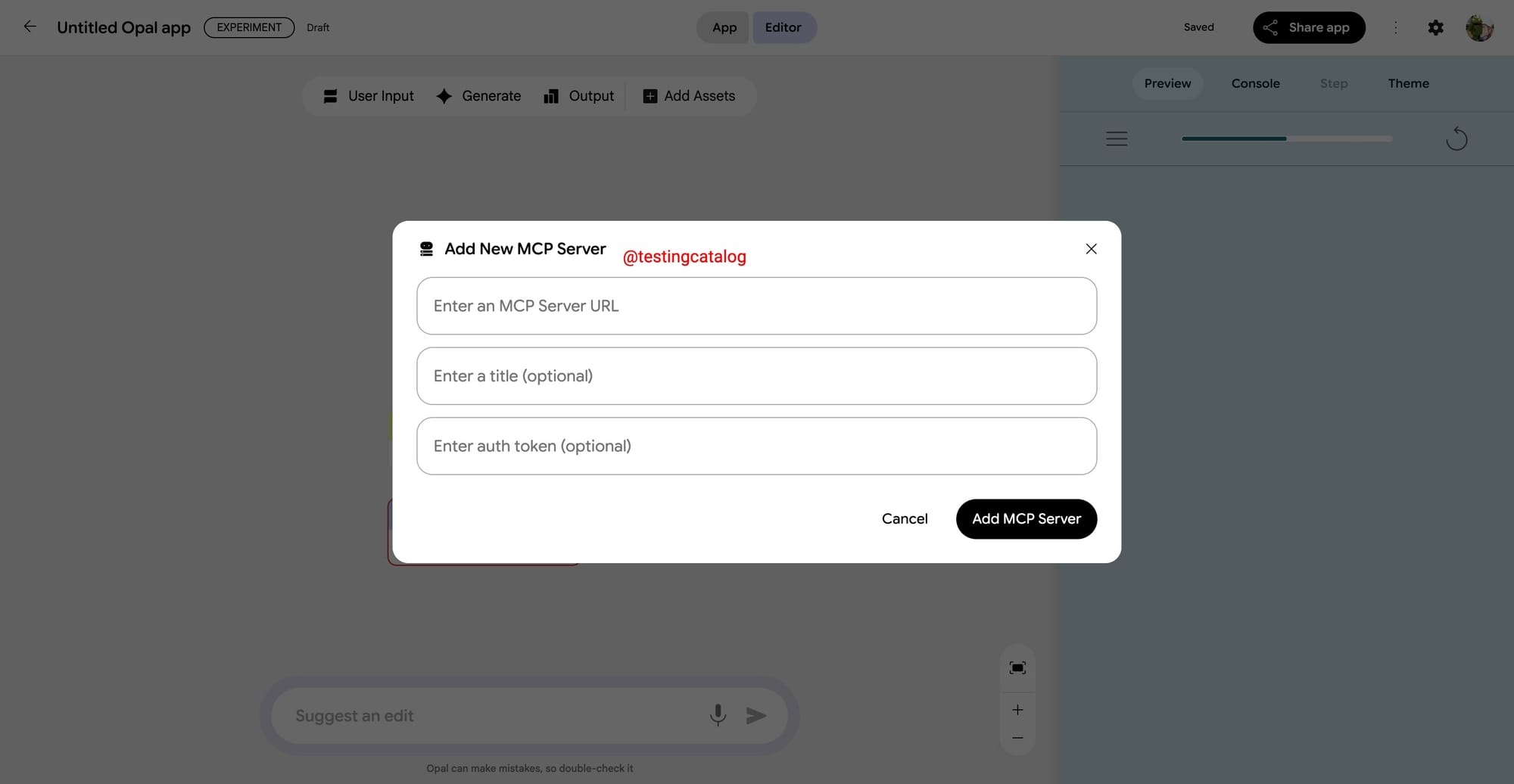
Google’s Opal, the company’s agent builder positioned as an answer to OpenAI’s recent Agent Builder launch, is beginning to show new ambitions with its upcoming MCP support. Opal initially launched as a lab product for US users, but has recently expanded into 15 additional countries. This wider rollout is likely driven by scaling and infrastructure considerations, reflecting Google’s step-by-step approach in contrast to OpenAI’s global push.
The latest discovery is a new section in Opal’s settings, referencing MCP (Model Context Protocol) configuration. Currently, the interface appears unfinished, with placeholders such as Google Calendar and the option to add custom MCPs. For Opal’s audience, primarily no-code or low-code users, MCP support would enable integrations with third-party services and custom tools, directly in workflows. This could close a feature gap with OpenAI, which already highlights MCP as core to its agentic platform.
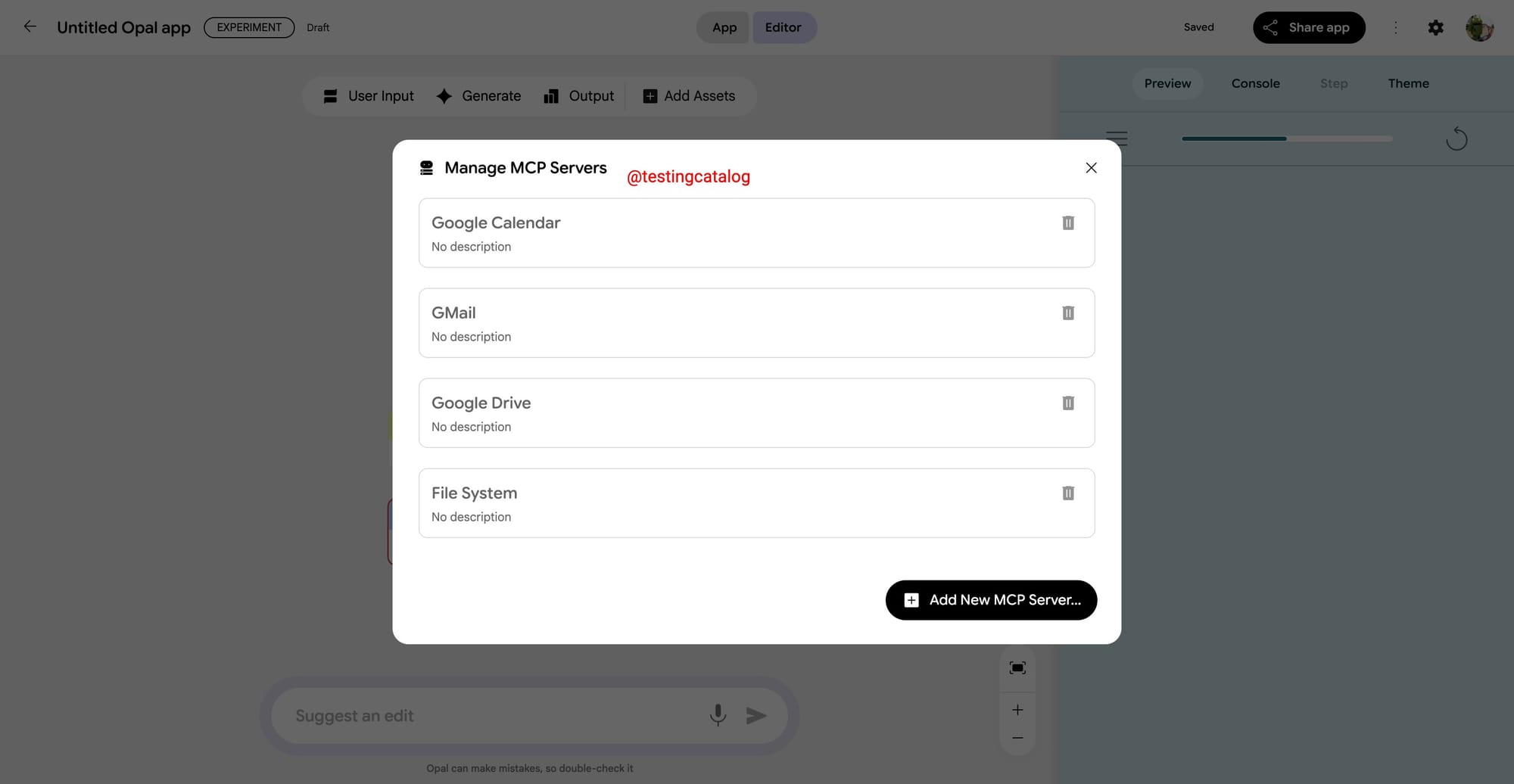
The potential for Opal users is significant: they’d gain access to richer integrations and the ability to automate tasks not just within Google’s ecosystem but also with external APIs. The “who” here includes no-code creators, power users, and teams who rely on automation and cross-tool connectivity but don’t want to write backend code. Feature-wise, Opal is already differentiated by its support for generating UIs, images, audio, and video inside flows—aiming to make agent-building more accessible.
No clear public release timeline for MCP in Opal has surfaced; the settings UI suggests early development. The feature was surfaced through app interface exploration, a common way these product details emerge in the AI space. For Google, integrating MCP aligns with its push to capture both the automation and creator tooling segments as competition heats up. Opal’s progress is one to watch, especially as OpenAI and Google continue to battle for the most flexible and extensible agent-building environments.


