
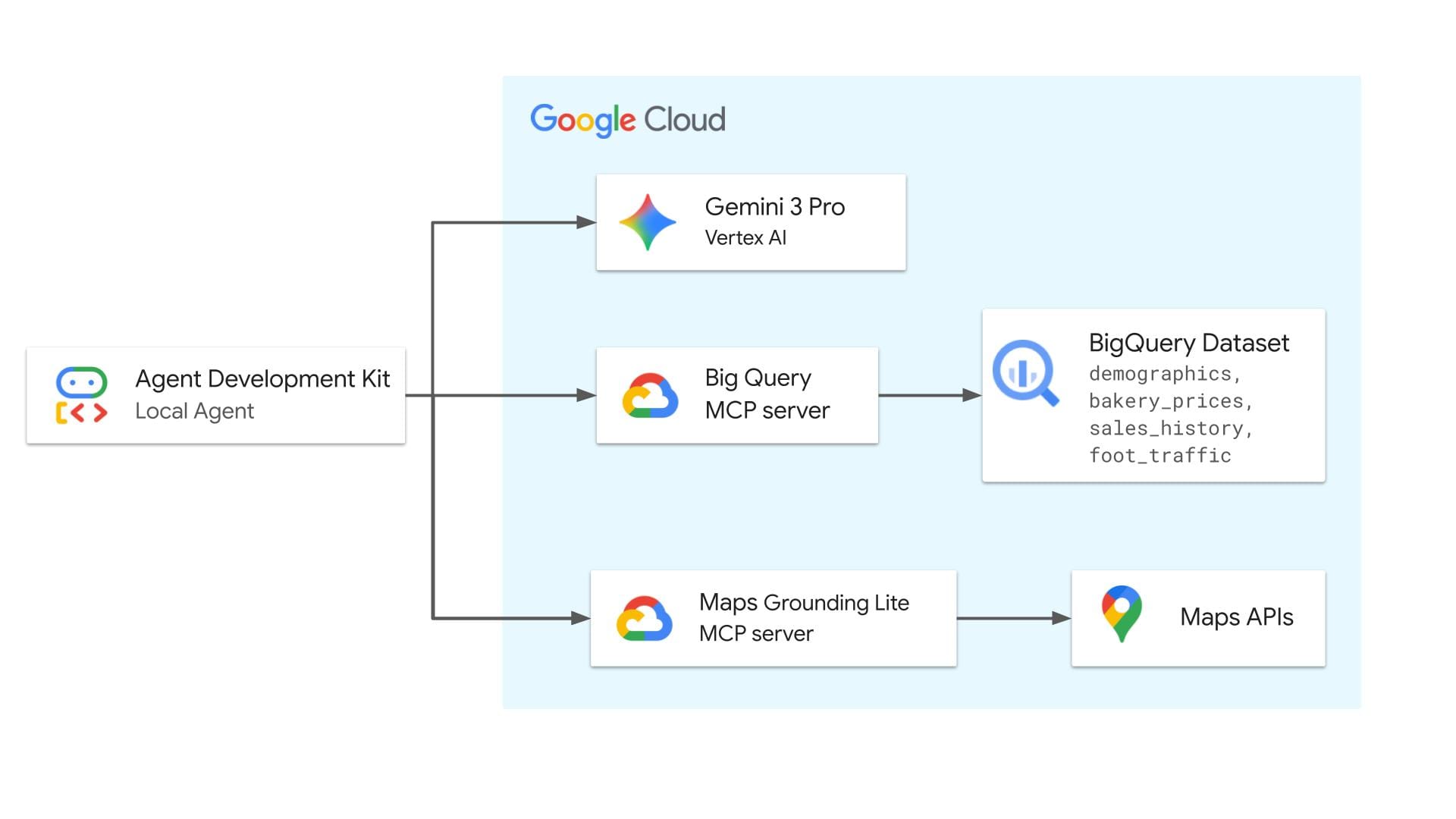
Google introduced fully managed MCP servers across Google and Google Cloud, marking a shift from community-built and locally installed servers to a unified, enterprise-grade endpoint for AI agents. The release makes Google’s API surface directly usable through the Model Context Protocol, giving developers a consistent remote interface for tools and data. The rollout began on December 10, 2025, with support for Maps, BigQuery, Compute Engine, and Kubernetes Engine, and is designed for developers building goal-oriented agents that require structured access to operational systems. Availability is global through standard MCP clients such as Gemini CLI and AI Studio.
The new Maps server provides access to Grounding Lite data, letting agents answer location, routing, and weather queries backed by Google Maps Platform. The BigQuery server allows agents to read schemas and run queries directly on enterprise datasets without moving data into prompts. Compute Engine exposes provisioning and scaling tasks through MCP for automated infrastructure workflows. The GKE server offers structured access to Kubernetes resources, replacing brittle text parsing with a reliable API surface suitable for autonomous or supervised operations.
Google is extending this capability across the broader enterprise stack through Apigee. Organizations can publish their own APIs, as well as third-party ones, as discoverable MCP tools. This integrates agents with custom business logic and governed data flows. Discovery and governance rely on Cloud API Registry and Apigee API Hub, with access controlled by Cloud IAM and monitored through Cloud audit logging. Model Armor adds protections against agent-specific threats.
The managed MCP layer supports enterprise use cases where agents combine reasoning from Gemini 3 with operational access. For example, developers can build a retail location analysis agent that forecasts revenue using BigQuery and validates surrounding business data and routes through Maps. Google plans to extend MCP support to Cloud Run, Cloud Storage, Cloud Resource Manager, AlloyDB, Cloud SQL, Spanner, Looker, Pub/Sub, Dataplex, SecOps, Cloud Logging, Cloud Monitoring, Developer Knowledge API, Android Management API, and additional services.
Google positions MCP support as foundational for agentic workloads and ties it to its role in the Agentic AI Foundation. The company states that this ecosystem focus accompanies advances in model capabilities to enable agents that can reason over data and take action across cloud and Google services.


