
Anthropic is developing a new Claude product called Penlight, designed to accompany clinicians during patient visits. It records conversations and transforms them into live, searchable AI sessions. According to code and an early interface reviewed by TestingCatalog, Penlight is intended to enhance clinical interactions by providing real-time transcription and interaction capabilities.
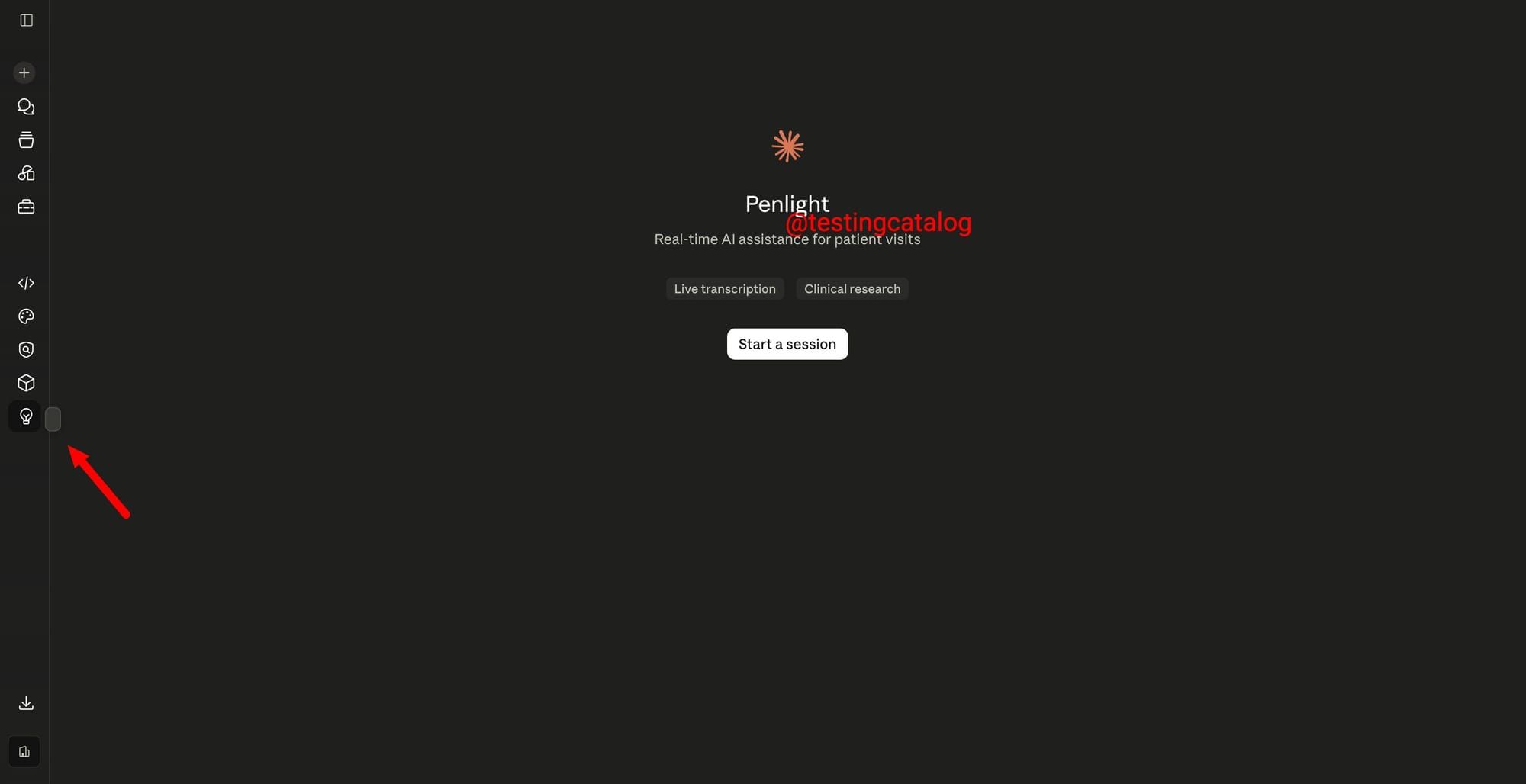
Penlight appears as a separate item under the Products section of Claude’s sidebar, alongside tools such as Claude Code, Design, and Conway. It features its own home screen and dedicated session pages, making it a standalone Claude experience rather than another mode inside the regular chat interface.
The product is currently hidden behind an internal feature flag, and its early interface is unfinished. Several labels are delivered through gated localization messages that were unavailable during testing, resulting in blank buttons and badges on the home screen. The Penlight name is confirmed by the sidebar and page-heading code.
Once a user begins a session, Penlight requests microphone access and starts streaming audio to a dedicated Anthropic service. The browser encodes the recording as mono Opus audio at 16 kHz, a configuration optimized for speech rather than high-fidelity playback.
The service produces a live transcript that can identify different speakers. Users can show or hide the transcript while continuing to interact with Claude in a parallel chat panel, allowing them to ask questions without leaving the ongoing visit. Penlight also tracks whether a recording is active on another device and offers a way to resume interrupted live sessions.
The underlying interface goes beyond basic transcription. Research results are structured around scientific articles and can include the journal, authors, publication year, DOI, and PubMed links. This suggests Penlight is intended to help users check clinical questions against medical literature while a conversation is still underway.
Every session is internally categorized as a “visit.” The service model also includes a field for a generated note, although the current interface does not appear to display that note yet. Together, these details point toward an ambient clinical assistant that could eventually transcribe an appointment, answer questions using medical sources, and prepare documentation for review.
The product’s home screen is built around a session list, with sections for recent activity and sessions that “need” the user’s attention. A persistent control can return the user to an active recording. This indicates Anthropic is designing Penlight as an ongoing workflow for managing multiple visits, not merely a one-off voice conversation with Claude.
Penlight aligns closely with Anthropic’s broader healthcare push. In January, the company expanded Claude for Healthcare and explicitly identified ambient scribing, chart review, and clinical decision-support tools as potential applications. It also added access to sources such as PubMed through its healthcare offering. Anthropic’s healthcare materials describe Claude as infrastructure for healthcare companies building those experiences.
Anthropic’s healthcare product page already demonstrates a workflow in which Claude turns a patient-visit recording into a clinical summary, assessment, and plan. Penlight appears to bring a version of that workflow directly into the main Claude application, with recording and assistance happening live rather than after an audio file is uploaded.
Important questions remain. The code does not establish whether Penlight is intended for individual clinicians, healthcare organizations, or an internal research program. There is also no visible information about EHR integrations, regional availability, compliance requirements, or pricing. Anthropic could substantially change or abandon the product before release.
Still, Penlight is one of the clearest signs yet that Anthropic is exploring first-party, industry-specific applications inside Claude. Instead of only supplying models to ambient-scribing companies, the company appears to be testing a clinical workflow of its own, one that listens during a visit, keeps Claude available in the room, and connects the conversation directly to medical research.


